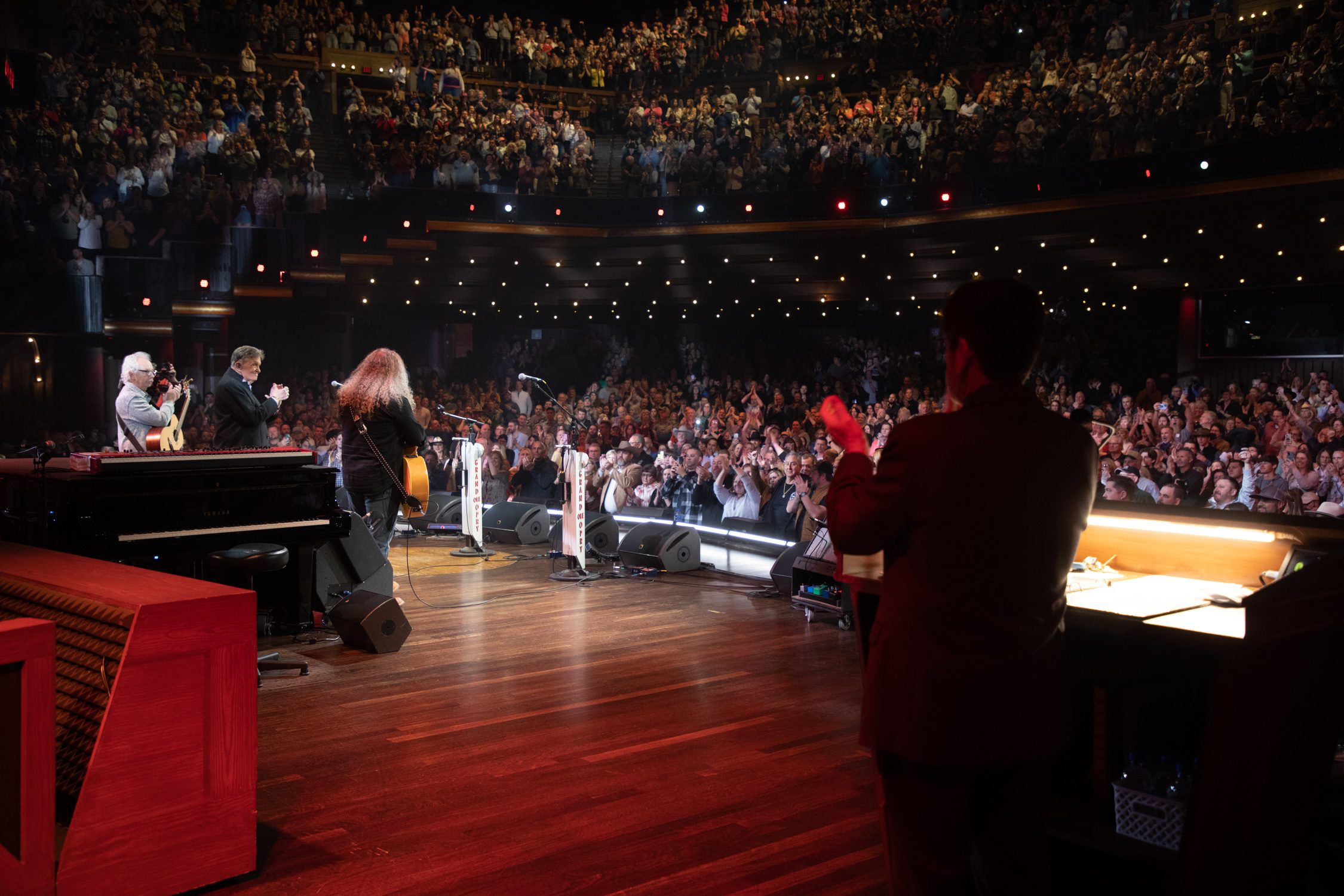
Elvie Shane Commemorates First No. 1 With Emotional Celebration For ‘My Boy’
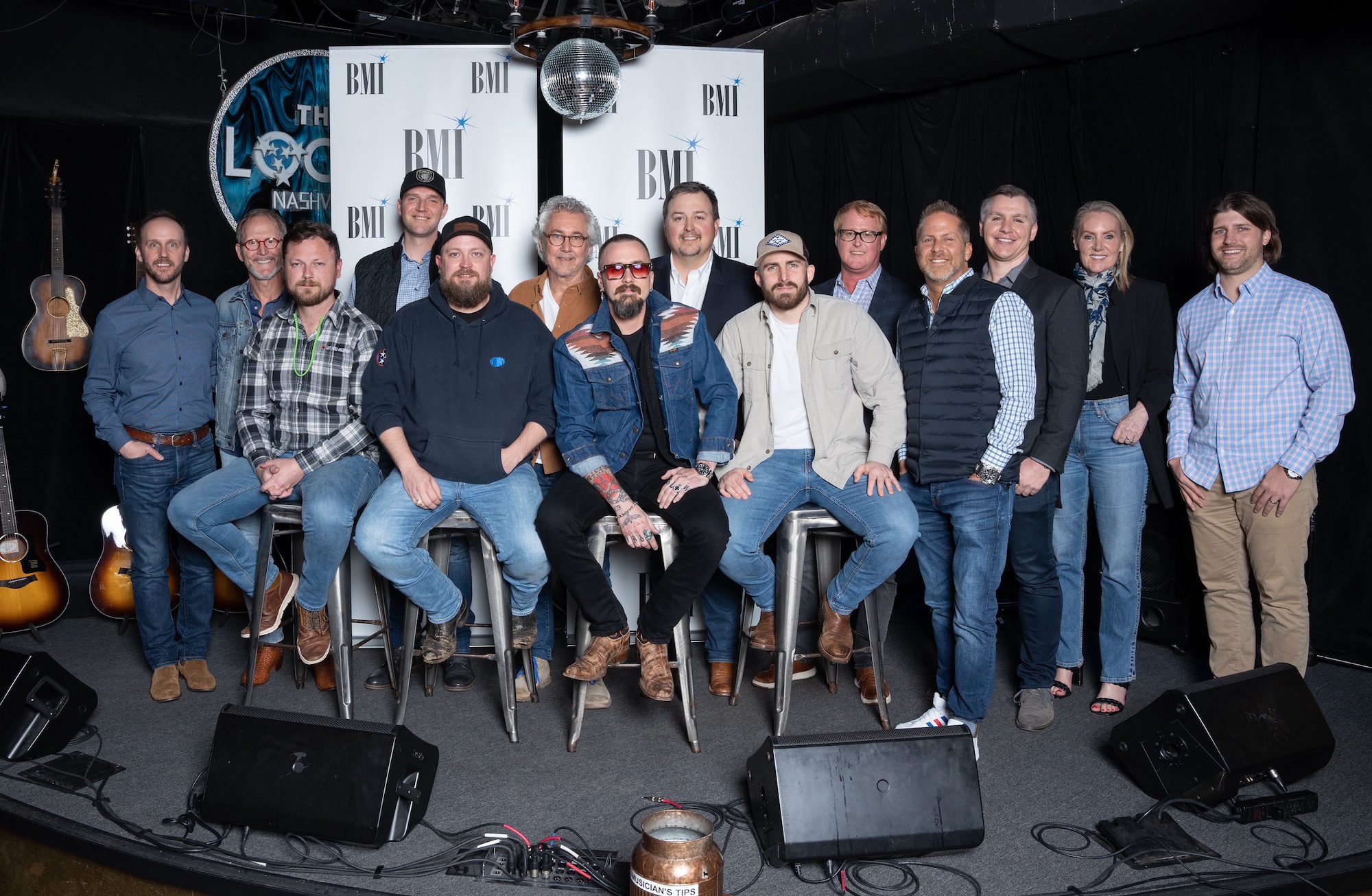
Pictured (L-R, back row): Rusty Gaston (Sony ATV), Gary Reamey (Block of Marble), Brian Wolf (Maverick Management), Clarence Spalding (Maverick Management), Mason Hunter (BMI), John Ozier (Reservoir Media), RJ Romeo (Romeo Entertainment Group), Lisa Johnson (Rome Phrey Publishing), Will Overton (Warner Chappell); (L-R, front row): Nick Columbia (Songwriter), Russell Sutton (Songwriter), Elvie Shane, Lee Starr (Songwriter), Jon Loba (Broken Bow Records). Photo: Steve Lowry

It was a family affair at The Local on Wednesday (March 23) when Wheelhouse Records singer-songwriter Elvie Shane and his co-writers celebrated their No. 1 hit, “My Boy.” The sentimental tune about nontraditional family dynamics was the first chart-topper for all four co-writers: Shane, Russell Sutton, Nick Columbia and Lee Starr.

BMI’s Mason Hunter led the festivities for the tune, which was inspired by Shane’s relationship with his stepson Caleb, who was in attendance.

Hunter set the tone for the rest of the team-member presentations that followed by recognizing how special of a song “My Boy” is. He let the room know that the song was written in 2016 on a porch in Hendersonville, and that all four writers were completely independent at the time it was written.

“This song gives all us the belief that great songs still live in this town,” Hunter said. “I can’t think of a better way to launch a career than with this single.”

Block of Marble and SNG’s Gary Reamey was on hand to support Starr. He called out the village of folks that had supported the writers on their climb to the top.

Sony Music Publishing’s Rusty Gaston, who Hunter referred to as the reverend, hit the nail on the head on how “My Boy” represents the spirit of Nashville.

Pictured (L-R): “My Boy” co-writer Nick Columbia, co-writer Russell Sutton, co-writer Elvie Shane, Shane’s Stepson Caleb, co-writer Lee Starr. Photo: Steve Lowry

“These guys didn’t write a hit song, they arguably wrote probably the best song in country music of the last decade. And they did it independently,” Gaston said. “It led to independent publishers championing them.”

Gaston added, “This town is built upon independent publishers like Gary starting these companies to take chances on people that are absolute dreamers and absolutely independent. Championing those dreams end up with songs that change people’s lives. That’s what happened here.”

Romeo Entertainment Group’s RJ Romeo and Rome Phrey Publishing’s Lisa Johnson—who were two of Shane’s first believers—spoke about the persistence of the writers. Johnson recognized Shane’s stepson Caleb. “If you hadn’t happened, nobody would be up here right now,” she said.

Warner Chappell’s Will Overton spoke about Shane, highlighting his wild exterior but tender heart. “It’s rare to meet someone who radiates the energy and creativity as much as Elvie does,” he said. “When I think of Elvie, I think LOUD—in all capital letters.”

Reservoir’s John Ozier was on hand to celebrate the company’s first in-person Nashville No. 1 party since opening in Music City in 2019. Ozier and his team represent co-writer Columbia, who got a custom guitar for his achievement.

“Every now and then there’s a song that stops you in your tracks, and you know exactly where you were when you heard it. This song did that for me,” he said.

Pinnacle Bank’s David DeVaul, donning a pair of similar-looking glasses to Shane’s signature look, let the crowd know that a donation had been made to SarahCare in honor of “My Boy.” Country Aircheck‘s Chuck Aly spoke about the feat of achieving a country radio No. 1.

When BBR head Jon Loba got up to speak, he highlighted the significance of the song. “This was a one-listen song for me. I wouldn’t hear of anything else but this being the first single,” Loba said, calling out the Wheelhouse promotion team for fighting for “My Boy.”
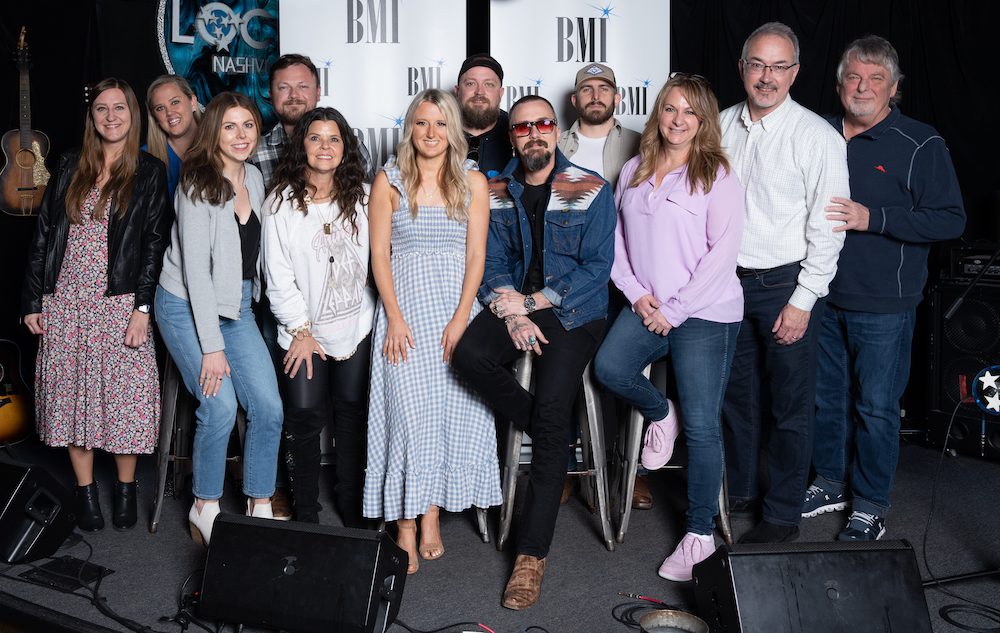
Pictured (L-R, back row): Ellen Ford (BBRMG), Nick Columbia (co-writer), Russell Sutton (co-writer), Lee Starr (co-writer); (L-R, front row): Ashley Wojcinski (BBRMG), Caitlyn Gordon (Wheelhouse Records), Kendra Whitehead (Wheelhouse Records), Brittany Pellegrino (Wheelhouse Records), Elvie Shane, Jennifer Shaffer (Wheelhouse Records), Ken Tucker (Wheelhouse Records), Carson James (BBRMG). Photo: Steve Lowry

When the writers spoke, the drinks and tears were flowing in the room. Each writer spoke about the night the song was written, and the struggle professional songwriters go through to make it happen.

“We were just four kids that were broker than hell, just trying to write something that mattered,” Sutton said. “These are three of my best friends in the world. I’d do anything for them.”

Sutton also pointed out that all four co-writers had all had babies since they wrote the song. “We had a promise of a check in nine months and were like ‘Let’s do it!” he joked. “That’s all gone now because we had those babies.”

Columbia thanked his family, co-writers and team. “Thank you guys for giving me a place to land,” he said.

Starr emphasized what “My Boy” had survived, and took time to encourage hopeful songwriters. “If there’s anyone out there who writes songs, you may have already done it and you don’t know it yet. For years we were sitting on [‘My Boy’], and we were struggling, wondering when our chance was going to come, when in reality, we had already written our check,” he said. “Keep fighting the good fight, keep believing in what you’re doing.”

Shane warned the crowd that he was going to be long-winded, as he grew up Baptist.

“I am going to cry because I’m a wimp and it’s what I do,” he joked. “I remember many nights sitting on the porch or tailgate talking about how we were going to take over this town. Started at the bottom, now we in the middle!” The crowd roared with laughter.

Shane recognized his team, co-writers and family, trying to hold back tears. “You work so hard for this. Not only as an artist or songwriter, but you have these people who take time away from their families and fly out to these cities and meet with radio people,” he said. “It’s such a long and hard process.

“Then you get a No. 1,” he said. “You dream about what it would feel like to get a No. 1. It didn’t feel right at first, but it feels right tonight.”

Looking For Work? Check Out MusicRow’s Job Board

With music industry professionals coming back to the office and live events returning, new job opportunities are opening up.

MusicRow wants to encourage its readers who are either looking for a music industry job or have an open position to fill to check out its Job Listings Board, located in the top menu bar on the MusicRow website.

Those who have full-time, part-time or temporary job opportunities can submit a form to list a job on the Job Listings Board. All job listings are free-to-list and will be posted for 60 days. Listings are accepted and published at the discretion of MusicRow.

Mary Jane Thomas, Wife To Hank Williams Jr., Suddenly Passes

Mary Jane Thomas and 2020 inductee Hank Williams Jr. seen during the 2021 Medallion Ceremony, celebrating the Induction of the Class of 2020 at Country Music Hall of Fame and Museum on November 21, 2021. Photo: Jason Kempin

Mary Jane Thomas, wife to country icon Hank Williams Jr., has passed away at the age of 58.

MusicRow has confirmed that Thomas passed away Tuesday (March 22) in Jupiter, Florida from what appears to be a complication following a recent medical procedure. At this time, her death does not appear to be suspicious.

Thomas, a former model for Hawaiian Tropic suntan lotion, has been married to Williams since 1990. The couple separated in 2007, but fully reconciled in 2011 as they celebrated their 21st anniversary.

The pair had 2 children together, daughter Katie Williams-Dunning and son Samuel Williams. In 2020, Katie tragically died in a car accident in Tennessee.

Sam Williams & Mary Jane Thomas. Photo: Courtesy of BB Gun Press

“My dear Mama Mary Jane was a beautiful soul who forever affected everyone who knew her,” Sam, who is also a rising country artist, shares in a statement. “She had a smile and presence that lit up every room and she never met a stranger she didn’t befriend. Her spirit was gentle and giving. She could take down a ten-point buck and fix dinner for her grandchildren at the same time! Now she gets to radiate from above with my sister Katherine Diana right by her side.

“She grew up competing in baton and cheerleading and was one of Hawaiian Tropic’s top models. My father fell in love with the Daytona Beach beauty the minute he set eyes on her in the early 80s. They went on to live the most powerful love story of travel and hunting and raising a family,” he continues. “Rest in peace Mama, I will always be the son of Mary Jane.”

Thomas is survived by Hank; parents Ramona and Bill; brother Andy; sister Angelason; son Sam Williams; and 3 grandchildren, Beau Weston, Tennyson Hiram and Audrey Jane.

My Music Row Story: Huskins-Harris’ Becky Harris

Becky Harris

The “My Music Row Story” weekly column features notable members of the Nashville music industry selected by the MusicRow editorial team. These individuals serve in key roles that help advance and promote the success of our industry. This column spotlights the invaluable people that keep the wheels rolling and the music playing.

Music industry veteran Becky Harris is one of Nashville’s top business managers. She started her firm, Huskins-Harris Business Management 14 years ago, where she handles business management and accounting for clients including her son, Chris Young, as well as Kane Brown, Riley Green, Alexandra Kay, Nick Conners, Angie K, Drew Baldridge, Frankie Ballard, Keith Anderson, James Stroud, and Absolute Publicity, among others. Under the Huskins-Harris umbrella, she and CPA/business partner Donna A. Huskins work for CeCe Winans.

MusicRow: Where did you grow up?

I was born and grew up in south Nashville. I grew up in the same house that my parents bought 6 months before I was born and sold 6 months after my son Chris [Young] was born. I lived in the same house my entire childhood.

Pictured (L-R): Becky Harris, Willie Nelson, Chris Young

How did you start your career?

When I was in college, I started out as a journalism major. I switched my major to literature and was going to teach college literature. I got married at the beginning of my senior year of college and graduated. In the summer after I graduated, they offered me an assistantship to work on my masters, and then I found out I was pregnant with Chris. Fast forward 13 months [after Chris was born], I had his sister. So I decided I could not go back to school with two little babies. Fast forward a few more years, I got divorced and I was raising two small kids by myself.

[When Chris was a kid], he ended up in a children’s theater group. They asked him to be part of a song and dance group. That’s when we realized he could really sing. When he was 15, this guy found us on the internet. He ended up being somebody who really didn’t know anything about anything. He had been a successful songwriter and he had an investor. I got panicked because now my kid was signed to a record deal and I didn’t know anything about this and this person didn’t either. I went to see an attorney, the attorney told me not to worry, that the deal would age out when he was 17. So I went back to school to get a second degree in the music business. After I graduated, another business manager here in town offered me a job so I went to work for him for seven or eight years.

What did you learn there?

The day I started they gave me James Stroud as my first client. James was running Dreamwork Records, had a studio, was one of the first guys in town to rent Pro Tools rigs, had publishing companies, had houses all over the place and hunted all over the place. I always tell everybody, “You want to learn how to be a business manager? Go to work for James Stroud.” I still have him as a client.

Pictured (L-R): Kane Brown, Becky Harris, Chris Young

You formed your business management firm, Huskins-Harris, in 2008. How did that come to be?

I quit [at the business management firm I was at]. My former boss passed away after I left, so James came with me. When I started, we didn’t really have any clients. We were going to take the people in Nashville that nobody else wanted. That was my business model. I thought I was going to work three days a week and Donna [Huskins], my business partner, was going to work two days a week. Now we work seven days a week. (laughs)

I had done a lot of things throughout my lifetime when my kids were little. I worked in accounting, human resources, and had been a personal assistant. I’ve done all kinds of stuff. Really the very first day that I worked for James, I thought, “This is everything I’ve ever done that I liked about every job I’ve ever had… all rolled into one thing.”

Business managers are some unsung heroes in the music industry. How do you approach business management?

We’re a little bit different than some business managers. We look at it as if it touches their money, it’s our job. So we actually get involved in a lot of stuff that some people don’t. I’ve done everything from going to somebody’s house at 8:00 o’clock at night to fix their microwave. We go get people’s car tags for them. We’re just very hands on. That’s part of why we stay a smaller firm. We over serve our clients, so I don’t take everybody. During the pandemic, a whole bunch of people called me saying “All your people are fine!” The sky fell and they were all fine.

The buck always stops with us. While we get paid the least amount of everybody, we’re always the ones that have to go to somebody else and go, “Nope, you can’t do that.” Whether that’s the artist, the booking agent, the manager, or the venue. We’re professional jackasses. (laughs)

Pictured (L-R): First National Bank of Middle Tennessee’s Ellen May, Becky Harris, SESAC’s Lydia Schultz and Shannan Hatch

Do you find it’s tough to be firm and decisive as a woman?

Not so much now as it was when I first started. I’ve been at this a long time—more than 20 years now. There weren’t a whole lot of female managers or female business managers [when I started]. Mary Ann McCready was it. She paved the way for everybody else. Now there’s Julie Boos, Kerri Edwards, Marion Kraft, and Ebie McFarland. There’s a group of people that are out there now, so you don’t have to prove yourself like you once did to be a female in the music business.

When do you feel most fulfilled in your role?

It’s always the firsts. At some point, they get to where they can afford to do whatever they want to do, but then they still have firsts. The first award, the first car they buy, the first time they get to take a bus, and their first No. 1. It’s the firsts.

I went with Kane [Brown] to buy his first truck. This was really early on—the very first year. He had always wanted this truck that somebody else had. He called me one day and he said, “Hey, I really want that truck. Do you think we can go get it?” I was like, “Yep, let’s go!” So I drove him to Chattanooga to get the truck. Now he’s a car guy, so he’s always got some car. But that very first truck was just super cool because he was like a kid at Christmas time.

You have a unique perspective on the music business, also being Chris Young’s mom. What has it been like to be in the music business and watch him work his way through it?

I was in the music business for about five years before he got record deal. I knew he was successful the day that it went from everyone introducing him as “Becky Harris’ son,” to “This is Chris Young’s mom.” Every group of people that start at a label, I have to re-prove myself. They’re always like, “Oh, you’re his mom. He put you in business.” I’m like, “No, that’s not quite how that happened.” (laughs)

You learn business lessons from every client, so it wouldn’t just be Chris. I’ve been through something with every client that’s given me a unique perspective on how to move forward with other people. If you don’t grow in this industry with the way it is right now, you won’t make it very long. Things change every year.

Pictured (L-R): Tyler Reeve, Becky Harris, Riley Green

What has been a big lesson you’ve learned over the years?

The thing that has affected me most is Route 91. Chris hadn’t intended to go there, he was going to hang out with a friend in San Diego. He changed his mind at the last minute and went by himself to Vegas.

I keep my phone on 24/7. All of my clients know that. My phone ringing always wakes me up, but I had a week where I didn’t sleep. Chris tried to call me multiple times that night and it didn’t wake me up. Kane did what I’ve always told him to do, he [kept calling] until I answered the phone. When I answered the phone, Kane goes, “Have you talked to Chris? You need to call him right now, there’s an active shooter in Vegas and he won’t answer his phone for me.”

From every business management perspective and every personal perspective, so many things came out of that. You’re always told to hit the ground when there’s a shooter. Well the shooter was above and when everyone hit the ground, a lot of people got hurt. But [in regards to] every safety protocol we had in place at the time, Route 91 was a cutting edge event. They had a fence up, they had metal detectors. You could not get into that festival with any kind of weapon. Nobody ever thought about somebody [shooting from] above. I deal with insurance, I deal with liability issues, I deal with protecting the personnel, personnel policies and all those things. That was a wake up call for everybody.

What’s some of the best advice you’ve ever gotten?

Don’t give up. Judy Harris is one of my mentors. She and Pat Rolfe have talked to me over the years. When I decided to go start a business for myself, they asked if I had any clients. I said, “No,” and they said “Don’t give up.” There’s been a number of times through the years that I’ve said, “Maybe I should retire,” and they’ve said “Don’t give up.” They weren’t wrong. Anything that you’re successful at, you have to work long hours. It’s like that in any career, not just the music industry.

What are you most proud of in your career?

That’s a hard one. Knock on wood they don’t all fire me tomorrow, but normally when somebody comes through my door, unless I tell them to go someplace else, they don’t leave.

I was Kane’s first business manager. I was Riley Green‘s first business manager. They come and they stay, thank goodness. I love that because I love growing a career with those people.

Memorial Service Held For Kenny Rogers Two Years After Death

Pictured: Kenny Rogers’ wife Wanda speaking at his memorial service on March 20, 2022 at Oakland Cemetery in Atlanta, Georgia. Photo: Ben Gray

Friends and family of the late Kenny Rogers gathered this weekend to finally memorialize his life and legacy, two years after he died. The service had been delayed due to the COVID-19 pandemic.

On Sunday (March 20) a small group of the Country Music Hall of Fame member’s close friends, family and band members gathered at Oakland Cemetery in Atlanta, Georgia to pay their respects. The ceremony was hosted by long-time touring partners Linda Davis and Billy Dean, and over fifteen speakers memorialized Rogers with stories and kind words.

The ceremony concluded with Dr. T. Lynn Smith and a gospel choir singing “Amazing Grace,” along with a pre-recorded Rogers vocal, and a performance of “Will The Circle Be Unbroken,” a favorite of the country legend. Brigadier General (Ret.) Richard McPhee gave Rogers an Irish sendoff as guests left the site.

At the reception, a brand new lyric video for Rogers’ song “Goodbye” was debuted for the first time ever.

Youtube video

According to a statement, the Rogers family would like to extend a public invitation for fans to visit his final resting place at the Oakland Cemetery. Details on visiting the site can be found at oaklandcemetery.com.

In his six-decade career, Rogers made an indelible mark on country music with enduring songs such as “The Gambler,” “Lady,” “Islands In The Stream,” “Lucille,” “She Believes In Me,” and “Through the Years.” In addition to being a Country Music Hall of Fame member, Rogers’ career achievements included 24 No. 1 hits, six CMA awards, three Grammy awards, the CMA Willie Nelson Lifetime Achievement Award, CMT’s Artist of a Lifetime Award, and more.

Rogers died on on March 20, 2020 at the age of 81.

Rhett Akins Moves Into Top Five On MusicRow Top Songwriter Chart

Rhett Akins

Nashville Songwriters Hall of Famer Rhett Akins has entered the top five on the MusicRow Top Songwriter Chart. Akins is a co-writer on Thomas Rhett’s “Slow Down Summer” and Parker McCollum’s “To Be Loved By You.”

Ashley Gorley maintains his eight-week reign at No. 1 on the chart as a co-writer of such songs as “New Truck” (Dylan Scott), “You Should Probably Leave” (Chris Stapleton), “Sand In My Boots” (Morgan Wallen), “Beers On Me” (Dierks Bentley, Hardy & Breland), “Slow Down Summer” (Thomas Rhett), “Give Heaven Some Hell” (Hardy), “Steal My Love” (Dan + Shay), and “Take My Name” (Parmalee).

Shane McAnally (No. 2) and Michael Hardy (No. 3) complete the top three on the MusicRow Top Songwriter Chart.

The weekly MusicRow Top Songwriter Chart uses algorithms based upon song activity according to airplay, digital download track sales and streams. This unique and exclusive addition to the MusicRow portfolio is the only songwriter chart of its kind.

Click here to view the full MusicRow Top Songwriter Chart.

Jamey Johnson Invited To Join Opry Family

Jamey Johnson & Bill Anderson. Photo: Chris Hollo

Jamey Johnson was invited to become a member of the Grand Ole Opry over the weekend.

Opry member Bill Anderson surprised Johnson with the invitation at the close of a writer’s round featuring Anderson, Johnson, and songwriter/producer Buddy Cannon.

Anderson opened the round by reflecting on the many times the trio spent writing together. During the show, they performed songs such as the smash “Give It Away,” which became a No. 1 for George Strait, “Everybody Wants To Be Twenty-One,” and “Cheaper Than A Shrink.”

Buddy Cannon, Bill Anderson, and Jamey Johnson. Photo: Chris Hollo

After their final song Anderson said: “Jamey, you made your Opry debut 17 years ago and you’ve been a frequent guest many times. But Opry management told me to tell you that this is going to be your last guest appearance.”

Johnson quipped, “Well, I’ve been kicked out of a whole lot of places.”

Anderson continued, “The next time you appear on this stage you will be the newest member of our Opry cast and family!”

“I accepted it 20 years ago! I really don’t know what to say except the obvious,” responded Johnson. “I love country music. I would have never moved here if it wasn’t for that; for the Opry keeping it alive and for the fans. I love you. Thank you.”

Johnson wrapped up the set and special moment with a solo performance of his song “In Color.”

An induction date for Johnson will be announced soon.

Cole Swindell & Lainey Wilson Hit No. 1 On MusicRow Radio Chart

Cole Swindell and Lainey Wilson are crowned No. 1 this week on the MusicRow CountryBreakout Radio Chart for their single “Never Say Never.” Swindell co-wrote the single with Jessi Alexander and Chase McGill and it will appear on his album, Sterotype, coming out in April.

Swindell and Wilson recently sat down with MusicRow to discuss the song. “I don’t know anyone who hasn’t been in this situation at some point in time,” Wilson says. “I was telling Cole the other day, it’s like that piece of chocolate cake that you know you shouldn’t have but you take it anyway. We’ve all been there, so we can all relate even if you’ve never been in a relationship in your life.” She continues, “It’s hard sometimes to have a rocking song that’s also passionate, and I think this song does that. It makes you feel all the things. It makes you wanna say ‘Hell yeah!’ and it makes you want to kiss somebody.”

Wilson recently won New Female Artist of the Year and Song of the Year for “Things A Man Oughta Know” at the 57th Annual ACM Awards.

Swindell is currently on his headlining “Down To The Bar Tour” with Travis Denning and Ashley Cooke.

Click here to view the latest edition of The MusicRow Weekly containing the MusicRow CountryBreakout Radio Chart.

DISClaimer Single Reviews: Randy Houser Makes Powerful Return

It seems that we salute our music-industry veterans today.

Deborah Allen, Sammy Kershaw and The Beach Boys are here with new sounds. So is Randy Houser, whose comeback wins our Disc of the Day prize.

Texas is well represented, with Ray Wylie Hubbard, Parker McCollum (singing Strait), Charley Crockett and Miranda Lambert all checking in with worthy new projects. That is also the home state of our DISCovery Award winner, Catie Offerman.

Happy listening.

PARKER McCOLLUM / “Carrying Your Love With Me”
Writers: Steve Bogard/Jeff Stevens; Producer: Jon Randall; Label: MCA
–McCollum salutes his hero George Strait with this revival of a 1997 chart topper. The youngster’s tenor voice brings out the yearning in the lyric beautifully. The session musicians’ instrumental coda is an extra delight.

MIRANDA LAMBERT / “Strange”
Writers: Miranda Lambert/Luke Dick/Natalie Hemby; Producers: Jon Randall/Luke Dick/Miranda Lambert; Label: RCA
–We can all relate. “Times like these make me feel strange.” The unsettling verses give way to a rollin,’ rollicking chorus: “Have a smoke, buy a round/Get on a jet going anywhere bound/Pick a string, sing the blues/Dance a hole in your shoes/Do anything to keep you sane.” Amen, sister.

CHRIS JANSON / “Keys to the Country”
Writers: Chris Janson/Dallas Davidson/Ashley Gorley/Zach Crowell; Producers: Zach Crowell/Chris Janson; Label: Warner
–It’s a blazing, high-octane performance that totally rocks. This record screams, “Spring is here” and “Turn it up.” Spin it until ya get dizzy.

LOCASH / “Beach Boys”
Writers: Chris Lucas/Preston Brust/Dallas Wilson/Jared Mullins/Brian Wilson/Mike Love; Producer: Cory Crowder; Label: BBR/Wheelhouse
–The vocal guests are veteran Beach Boys Mike Love and Bruce Johnson. The song is a mash up of “I Get Around” with some LoCash redneck verses. It’s a bit of an audio mess, but they mean well.

CHARLEY CROCKETT / “I Feel For You”
Writer: Jerry Reed; Producer: Billy Horton; Label: Son of Davy/Thirty Tigers
–Moody, bluesy and utterly captivating. With spare snare drumming and acoustic strumming as the underpinning, Crockett gives the heartbreak tale a smoky vocal magic. I dig this guy’s “Gulf and Western” sound.

RANDY HOUSER / “Note to Self”
Writers: Randy Houser/Ross Copperman/Casey Beathard/Bobby Pinson; Producers: Randy Houser/Blake Chancey; Label: Empire/Magnolia
–This man remains one of country music’s very finest vocalists. His return is most welcome, especially with such a strong song of regretful hindsight. His extraordinary voice is absolutely fierce as this hair-raising pile driver reaches its climax. Houser is booked to play the Ryman on Sunday (March 20).

CATIE OFFERMAN / “Happyland Trailer Park”
Writers: Catie Offerman/Joe Clemmons/Rodney Clawson; Producer: Dann Huff; Label: MCA
–Lend this newcomer your ears. The Texas twanger takes us on a jingle-jangle, country-rock cruise on her disc debut. It’s a wind-in-your-hair pleasure trip. Tow an Airstream down the highway until you get to the title destination.

SAMMY KERSHAW / “Honky Tonk Boots”
Writers: Billy Don Bruns/Scott Blackwell; Producer: Buddy Cannon; Label: White Mustang
–Stone cold country, designed for two-stepping. Old-school, and proud of it.

MAGGIE ROSE / “Two Arms to Hold Onto”
Writers: Chris Gelbuda/Don Hart/Maggie Rose; Producers: Don Hart/Chris Gelbuda; Label: MR/Orchard
–Maggie is a dynamite talent as a blue-eyed soul singer. On this lustrous wish for love, she claims her turf as a country queen. The ear-tickling production sports strings as well as twang. She introduced the song at the Opry last Saturday, and charmed everyone in sight. I remain an immense fan.

ZAC BROWN BAND / “Out in the Middle”
Writers: Ben Simonetti/Jonathan Singleton/Luke Combs/Zac Brown; Producers: Ben Simonetti/Zac Brown; Label: Warner
–This band doesn’t know how to make a record that isn’t hooky. This song is another one of those redneck-fantasy lyrics about swimming holes, gravel roads and rural partying after a hard-working week. But they sing it with such gusto, you buy it all over again.

DEBORAH ALLEN / “Patsy Cline Crazy”
Writers: Deborah Allen/Margaret Phillips; Producer: Deborah Allen; Label: Audium/BFD
–Allen sings with oomph and passion on this clever ballad. The lyric name checks 25 country classics (I counted) and along the way manages to sound like an instant classic, itself. Very cool.

RAY WYLIE HUBBARD & BAND OF HEATHENS / “Desperate Man”
Writers: Eric Church/Ray Wylie Hubbard; Producer: none listed; Label: Big Machine
–Hubbard’s second album of collaborations drops tomorrow (March 18). It features the eclectic Texas troubadour warbling with Steve Earle, Willie Nelson, Wade Bowen, Wynonna, Randy Rogers and Hays Carll, plus such unlikely collaborators as Toto’s Steve Lukather, Heart’s Nancy Wilson, metal rocker Lizzy Hale, Ringo Starr and the Shiny Soul Sisters. The single is Hubbard’s drawling treatment of the 2018 hit he wrote with Eric Church. I’ve always loved this rumpled, honest fellow.

My Music Row Story: UMPG’s Troy Tomlinson

Troy Tomlinson

The “My Music Row Story” weekly column features notable members of the Nashville music industry selected by the MusicRow editorial team. These individuals serve in key roles that help advance and promote the success of our industry. This column spotlights the invaluable people that keep the wheels rolling and the music playing.


This edition of “My Music Row Story” is sponsored by Worldwide Stages.


A 37-year publishing veteran, Troy Tomlinson is in charge of day-to-day operations for Universal Music Publishing Nashville. Among his current writer/artist hitmakers are Taylor Swift, Kenny Chesney, Keith Urban, Maren Morris, Luke Combs, Shania Twain, Chris Young, Brandi Carlile, Brad Tursi (Old Dominion), Scotty McCreery, Sam Hunt, Ingrid Andress and Caitlyn Smith.

Notable hit songwriters at UMPG include Chase McGill, Paul DiGiovanni, Justin Ebach, Lee Miller, Sam Ellis, Derrick Southerland, Ray Fulcher, Jacob Davis, Shane Minor, Bart Butler, Jamie Paulin, Troy Verges, John Pierce, Greylan James, and Dave Cobb, among many others.

Prior to UMPG, Tomlinson served as President and CEO of Sony Music Publishing Nashville from 2002 until 2019. Before that, he served as EVP of Acuff Rose Music Publishing from 1988 until 2002.

MusicRow: Where did you grow up?

I grew up up 40 miles north of here on the Kentucky line in a little town called Portland, Tennessee. I grew up on a beef cattle farm. My brother and I roamed the 80 acres that we had and had a really great childhood that made us grow up to be curious. There was just so much to explore on that farm and it really did expand this notion of curiosity for me. That’s been something that I cherish now as an adult looking back on it because we really don’t meet a lot of people in our creative business who don’t have a sense of curiosity, because that’s what spurs creativity.

Pictured: Troy, asleep in the tape room.

Did you always want to work in the music business?

When I graduated high school, I went straight to work at a plastic injection mold company, in a mentorship program. I was burned really badly on both my hands. I had second and third degree burns on both hands from this accident that happened with 700 degree molted plastic.

At the same time, I was volunteering for a civic organization called the JCs, or the junior chamber of commerce. We did about a dozen events each year to raise money for one event a year, which was to take underprivileged children in our area Christmas shopping and to throw a big Christmas party for them. I became president of the JCs when I was 19 or 20.

At my induction as president, there was a guy there that I had only met a couple of times named Cliff Williamson. So fast forward a few months, I’m laying in a burn unit here in Nashville with skin grafts on my hands, and Cliff called me. He said, “Hey man, have you ever thought about changing careers?” I was thinking, “As a matter of fact, I’m thinking about it right now!” (laughs)

Cliff hired me as a tape copy boy and as a beginner song plugger to teach me the art of song plugging at a company called Multimedia, which was a New York firm that owned TV shows like The Phil Donahue Show, Sally Jessy Raphael’s show, and some early talk shows. They also owned Channel 17 here in town and a magazine called Music City News. Cliff just thrust me into this world that I could have never really imagined being a part of.

Troy with Reba McEntire.

After getting your start at Multimedia, where did you go next?

When Multimedia was prepared to sell off pieces of the company, they began to do layoffs. I got laid off after a little over two years.

One of my writers was a writer named Don King. Don had built a new studio and started a little side publishing company. He and his father, Don Sr., asked me to come and work for them to help build up a roster. I stayed there for a couple of years. Then Rick Hall—the Muscle Shoals mogul, producer and publisher—had an opening for someone to run his Nashville office. He hired me to do that.

I was only there about a year and I learned so much. I learned what standards were. Rick Hall taught me the difference in hit songs and standards in American culture. That catalog that he owned, Rick Hall Music and FAME, it’s a patch quilt made of America’s music standards.

Then you went to work for Jerry Bradley at Acuff Rose.

All those years prior that I had been in the business, Acuff Rose and Tree Music Publishing were, to me, the preeminent country catalogs. Jerry Bradley was running Acuff Rose, and they were reinvigorating the sleeping giant [that the company had been]. It had drifted when Mr. Fred Rose became ill. So Jerry Bradley hired me and pushed me out in front of our parent company, Gaylord Entertainment and Mr. Bud Wendell, every time he could. If Jerry couldn’t be at a meeting, he pushed this little 24-26 year-old to go sit in for him in these corporate meetings and make presentations. That’s the mentoring that he did, he pushed me to the front of the stage, metaphorically.

I worked for Acuff Rose from ’88 to 2002, and moved up the ladder in that company to my final position, being Executive VP of the company and Jerry as the President. Then we were bought by Sony, and Donna [Hilley] allowed me to come over and bring a half dozen of my employees with me to Sony.

Kenny Chesney and Troy accept a BMI Award.

You had many successful years at Sony Music Publishing, and then left in 2019 to become Chairman/CEO Of UMPG Nashville.

We become an aggregate of all of life’s experiences, the good ones and the bad ones. That period working for Jerry, and then that period working for Martin [Bandier, former CEO/Chairman of Sony/ATV] were the largest aggregation of knowledge about publishing for me.

Marty was retiring and changes within Sony were occurring. At the same time, Jody Gerson, who I had worked with for a number of years at Sony and always respected and admired so much, we had breakfast together in LA at some function we were both attending. At breakfast she proposed that we find a way to work together. She was very convincing and ultimately, I made what, in one respect, was a difficult decision because myself, my staff and most people on Music Row thought that Sony/ATV is where I would spend the rest of my career.

In that regard, it took some thinking to process why I should do it. The reason I ultimately did it was I knew Jody was another one of those people that would mentor me, support me and grow me in that sphere of influence that a publisher has. I also watched the culture she had built at Universal Music Publishing since she got there and was blown away. She’s a culture-centric leader, it’s very top of mind with her.

That was a little over two and a half years ago now. Of course two years of that has been eaten up by COVID, but we’ve not only nixed a beating, but we have grown remarkably in every measurement over COVID. That’s a testimony to the employees here and the support that Jody has given us.

Looking back, what are some of the first few songs you remember having success with?

The first No. 1 that I pitched was the Alabama song called “If I Had You.” Barry Beckett, a dear friend who’s gone now, cut one album with Alabama. I’d known the boys from Alabama since I was a teenager through a variety of interesting ways. But my first pitch appointment at Acuff Rose when I got hired was with Beckett. I wanted to impress Mr. Bradley that I could get Barry Beckett in the room.

He was producing 15 acts at the time. So Beckett came down at the end of the day. He was tired and was notorious for falling asleep during pitching appointments, which was beautiful. You’d cough really loud or turn the volume up real quick [to wake him up]. (laughs) The last song on the tape was the Danny Mayo and Kerry Chater song, “If I Had You.” It was just a work tape. When it finished, Beckett said, “Randy will love that, I’ll love cutting it, and we’ll have a hit together.” Within six months, we had a No. 1 record.

Interestingly enough, as I told you, “If I Had You” was the last song out of 10 that I played Barry that day and it was the only one he loved. Fast forward a few months or a year, I’m in our new building at Acuff Rose, playing for Jerry Fuller and John Hobbs who were producing Collin Raye. The first song I played them was “Love, Me.” We had a No. 1 on it. I played them three or four more and every time they’d pass on one, they would say, “We gotta cut that first song.” So after four songs, I could see where the meeting was going, and I said, “Do y’all just want to stop listening and go to lunch?” They said, “Yeah!” (laughs). We didn’t listen to another song. I’ll never forget that. That was a wonderful experience.

Taylor Swift and Troy accept a BMI Award.

What are some of the best qualities about our industry?

We are truly a community. We’re not strung out miles apart like Los Angeles is forced to be. We run into one another and spend time with one another at the ball field, concerts, restaurants and clubs. We have a sense of community. LA, New York and Atlanta all have their own sense of community, but there’s no question that this is pretty unique.

Earlier this week I was in a label meeting with three other heads of Nashville publishing companies, and we’re all in there together talking, conversing, asking questions and sharing together. That’s a little more iffy in other places. Obviously we all compete with each other in a certain sense, because you’re trying to get the cut or have the hit, but in another sense, we truly are friends. That’s what sets this community apart.

One of the most satisfying things about the Music Row community is raising a child around all these gifted songwriters who are such characters and then having that child grow up and want to work in that same culture, both with some of those same writers but also with their own generation of creators. Seeing my son Joshua, find his place in this community as songwriter representative at BMI has been particularly gratifying.

Troy (middle) with his wife Sylvia, and son Joshua, who is also in the business as Director of Creative in Nashville’s BMI office.

What does it take to be a successful person in business and in life?

There is a a quote from To Kill A Mockingbird that I try to live by. It’s when Atticus is sitting with Scout, his young daughter who’s really torn up inside because she sees the divisiveness in their community over this false accusation of rape by a Black man. She sees this miniature culture war that’s happening all because of this lie that’s told. She’s obviously trying make sense of it and, I’m paraphrasing, but Atticus says that great line: “You never really understand a person until you consider things from his point of view…until you climb into his skin and walk around in it.” I would say that, one of the ways that one might measure success that seems more important to me than a lot of other ways we can measure it, is what Atticus was describing: empathy. Putting yourself in another person’s shoes to the best that you can.

I really believe with all of my soul that you will look back on your career and call it successful if you have loved the people that you work with, if you’ve poured yourself into it, and if you have tried your best, even in difficult times, to show them empathy. Even when we disagree, even when it’s hard to show empathy toward people, I believe that would be the premier expression of success for me. If I’m doing that, I can feel successful. And if people see me doing that, they might consider me successful.

The string of No. 1s or the string of awards from organizations, all the pictures that we take with ourselves and with artists, all that’s wonderful—that’s part of our culture and who we are. It’s all important and a joyful experience. But if we gain all that and we sacrifice loving one another and showing empathy to one another, all that other stuff is just a breeze that blows by for a second and is gone. That would be my underlying definition of success.