Tag Archive for: featured-2

Save The Date: ASCAP Country Music Awards Set For November 6

The 55th annual ASCAP Country Music Awards will be held on Monday, Nov. 6 at the historic Ryman Auditorium and will include the announcements of the ASCAP Country Music Songwriter of the Year, Songwriter-Artist of the Year, Song of the Year and Publisher of the Year.

The evening will feature live performances of some of the top five most-performed songs by the award-winning songwriters and/or the artists who recorded them.


Triple Play: Chris Young Celebrates No. 1 Song, Platinum Album, And Grand Ole Opry Membership

Vince Gill invites Chris Young to become the newest member of the Grand Ole Opry, August 29, 2017. Photo: Chris Hollo/Grand Ole Opry

Chris Young checked more milestones off his bucket list Tuesday night (Aug. 29) at the Grand Ole Opry, with a triple celebration.

The highlight of the evening came when Young was surprised onstage by his “Sober Saturday Night” collaborator Vince Gill, who asked Young to become the next member of the Grand Ole Opry. Young made his Opry debut in 2006. His formal induction will take place Oct. 17, just days before the release of his seventh album, Losing Sleep.

“I love playing on that record and it was fun, but I heard about all that money you raised for Texas,” Gill said, referring to the GoFundMe account that Young recently set up to help those affected by Hurricane Harvey. “Good hearted boy, but I never got paid for that session,” Gill said jokingly, “and I’m still five years away from social security. I tell you what. I’ll make you a deal. I’ll forgive the session fees if you’ll become a member of the Grand Ole Opry.”

Young gave Gill a bear hug as the audience offered a standing ovation.

“You are getting triple scale at this point,” Young replied. “I was standing backstage wondering why you were making me [perform] last?”

“Now you know,” Gill quipped. “So will you?”

“Yes, 100 percent,” said Young.

YouTube video

Before his Grand Ole Opry set, Young checked off another bucket list item, earning his first platinum album with the news that his 2011 album Neon has been certified platinum by the RIAA. He also received plaques honoring the success of his radio singles “Think Of You” (RIAA certified Platinum) and “Sober Saturday Night” (RIAA certified Gold), which brings Young to a total of 16 gold and platinum certifications.

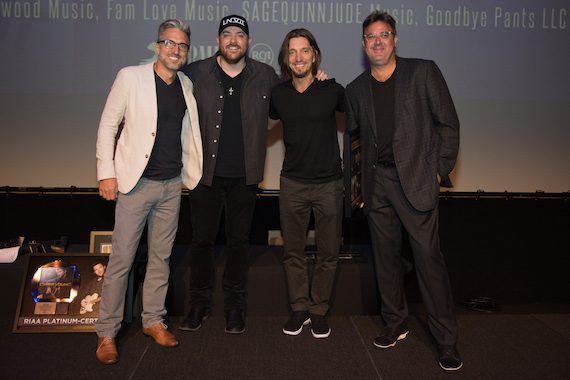
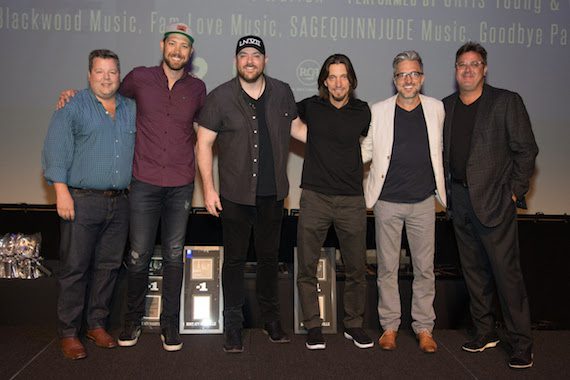
The Warren Brothers, Chris Young and Vince Gill celebrate the chart-topper “Sober Saturday Night” during a No. 1 party at the Grand Ole Opry

Earlier in the evening, Young celebrated his most recent chart-topper, “Sober Saturday Night,” with a No. 1 party backstage at the Opry with his  co-writers Brad and Brett Warren, as well as with Gill, who provided harmonies and guitar work on the track.

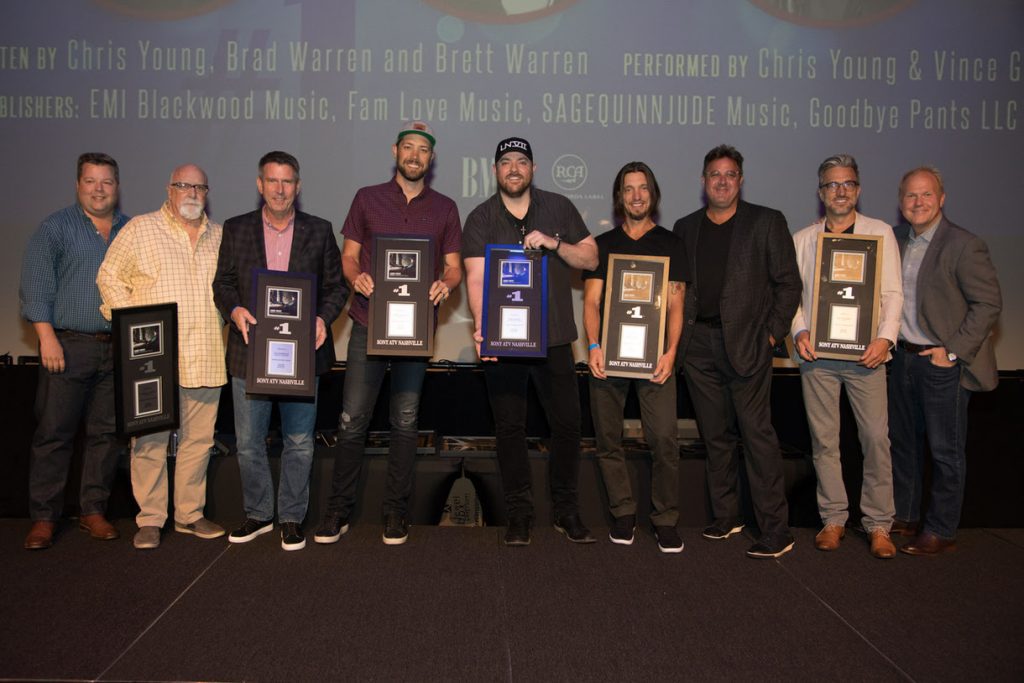
BMI’s Bradley Collins, Sony/ATV’s Troy Tomlinson, Young’s “Sober Saturday Night” producer Corey Crowder, Young’s manager Larry Fitzgerald, RCA Nashville’s Sr. VP/Promotion Dennis Reese, and more gathered to celebrate the chart-topping single.

“I set out all these years ago to be a supporter,” said Gill, “I wanted to be one of those guys you read about on the back of a record jacket, or played a guitar part or harmony part. Over the past 42 years now, I’m at about 1,000 artists’ records that I’ve had the privilege of getting to contribute. These are some great guys and I’m glad to be included. I got to strap on a loud guitar and play a solo and sing the high parts that were too high for Chris.”

“That’s true,” Young quipped.

“Getting to work with Corey has been such a cool thing for both of us, but especially for me because we see eye to eye in the studio. We both have the same vision and someone who is as talented as he is is very special to get to work with.

Pictured (L-R): BMI’s Bradley Collins, Corey Crowder, Chris Young, Brad and Brett Warren and Vince Gill. Photo: Chris Hollo/Grand Ole Opry

“Brad and Brett, thank you for even getting in a room with me. It was an honor to write that song together. I remember when I got Vince on the song, I called both of you guys and you were like, ‘We’re on the Row,’ and you came over and we sat in the truck and I played you the first early cut of it.”

Young also gave props to Sony/ATV’s Troy Tomlinson, whose response to first hearing “Sober Saturday Night” proved prophetic.

“Troy Tomlinson, when I sat in the room with you and played you some music off the new record. When I played this song, he said, ‘Hang on a second.’ He took stationary out of his desk, wrote a note, put it in and envelope, seals it and says, ‘Don’t open this until it’s a single.’ I put it in my truck. My truck had to go int he shop and I left it there because I had been gone touring. The song went No. 1 so I got my truck an I opened it and it’s him going, ‘This is undoubtedly a No. 1 song. There is no doubt in my mind, so I hope when you open this we get to celebrate together.'”

And celebrate they did last night, with Young as the newest member of the Grand Ole Opry.

Pictured (L-R): Bradley Collins – BMI, Larry Fitzgerald – Fitzgerald Hartley, Dennis Reese – Sony Music Nashville, Corey Crowder – Producer, Chris Young, Brad Warren, Vince Gill, Brett Warren, Troy Tomlinson – Sony/ATV Music Publishing. Photo: Chris Hollo/Grand Ole Opry

‘MusicRow’ Announces Promotions: Jessica Nicholson, Eric Parker

MusicRow announces the promotion of two of its team members, Jessica Nicholson and Eric Parker.

Jessica Nicholson has been promoted to Managing Editor for the publication and has been covering the Nashville music industry as part of MusicRow magazine since 2012. She previously served as a staff writer at Country Weekly magazine. Her music journalism experience also includes work with CCM Magazine.

Nicholson graduated from Belmont University with a degree in Music Business and Marketing. She is a member of the Country Music Association and SOURCE.

Eric T. Parker has been promoted to Operations Director, overseeing the production of six print magazines and expanding the internship program. Parker produces three annual events for the enterprise—the MusicRow Awards, Rising Women on the Row, and the MusicRow Meet & Greet and the CountryBreakout Awards—in addition to contributing editorial for print and online, overseeing subscription services and running the song tip sheet RowFax.

A California native, Parker graduated from the Mike Curb College of Entertainment and Music Business at Belmont University before being hired at MusicRow in 2010 to assist with the CountryBreakout Chart.

MusicRow Publisher and Owner, Sherod Robertson states, “I am convinced the single most important ingredient of a successful company is having the right team. Everything else depends on it. Each member of the MusicRow staff plays a critical role in our organization so I’m pleased to recognize the efforts of these two individuals who have been a part of MusicRow for many years.”

Robertson adds, “The resourceful and compelling content MusicRow produces each and every day is a testament to Jessica Nicholson’s unwavering ability as both a writer and managing editor. She has a tremendous ability to keep up with the many happenings on Music Row. Eric Parker’s passion for the industry far exceeded his part-time status at the company when I acquired the publication in 2010. That passion moved him into a full-time position shortly afterwards. With the experience he has gained over the last six-plus years, Eric has parlayed those skills into a valuable and important role in our company.”

Jessica Nicholson can be reached at jnicholson@musicrow.com and Eric Parker can be reached at eparker@musicrow.com.

Carter Winter Signs With Roc Nation

Carter Winter has signed a publishing deal with Roc Nation.

Winter recently finished his second studio project, The Whiskey In Me, which was produced by Mark Bright and Chad Carlson and reached the No. 4 spot on iTunes and No. 34 on Billboard‘s country albums chart. He is a spokesperson for Durango Boots and has his own line of boots coming out soon.

“I signed with Roc Nation and could not be more excited or thankful to be part of this incredible family,” said Winter. “To have the brilliant individuals associated with this business and movement believe in me is more than I could have ever imagined. Love the ones who love you. Do the best for those who want the best for you.”

Roc Nation announced a publishing partnership with Warner/Chappell Music last year as well as a joint venture, Rhythm House, with songwriter/producer/publisher/DJ Jesse Frasure.

Honor Thy Music: Preserving Country Music History In The Digital Age

When iconic country songwriter Bob McDill left his life’s work—217 legal pads filled with handwritten lyrics to more than 200 recorded songs, some of which would become classics like Alan Jackson’s “Gone Country” or Keith Whitley’s “Don’t Close Your Eyes”—it was a boon for the Country Music Hall of Fame and Museum.

“These are like finding lost books of the bible or apocryphal pieces that people talk about,” Carolyn Tate, the Country Music Hall of Fame and Museum’s Sr. VP of Museum Services, tells MusicRow. “To find a body of work that has been saved or put to paper like that is phenomenal.”

Donations such as McDill’s are also increasingly rare, in an age where songwriters rely more on computers than paper when crafting country radio’s latest hits.

“These days when you go into a writing room, nine out of 10 songwriters open up their computer,” says Kix Brooks, who has made several donations to the Country Music Hall of Fame and Museum over the course of his 30-plus year career.

“The thing they most love [at the Country Music Hall of Fame and Museum] are those handwritten song lyrics for the songs that you were working on that turned out to be hits,” he says. “I can’t imagine how much paper I’ve dumped over the years that they would have cared about and looking back, fans would have too. But I did find a piece of ‘Red Dirt Road,’ and a piece of ‘Only In America,’ where I was working on it. Some of the lyrics I started with, kind of made me smile, but they were happy to get those. I wish I had done a better job of sending that stuff.”

“As historians, we have to point out how strong the written word is,” Tate says. “We hope it sends a message to other songwriters and folks in town that these things are so meaningful to history and take another look around their own basements.”

While country music fans are no doubt familiar with the Country Music Hall of Fame and Museum’s ever-rotating exhibits, as well as the 776-seat CMA Theater, 213-seat Ford Theater, the Taylor Swift Education Center and the Country Music Hall of Fame and Museum’s work with Hatch Show Print and RCA Studio B, the operation has long chronicled the complex and far-reaching history of country music’s stars and industry members.

Since 1987, the Country Music Hall of Fame and Museum has been accredited by the American Alliance of Museums, which certifies that the museum operates and manages its collection of more than 2+ million artifacts at the highest standard of quality. Those items include 200,000+ recordings, as well as stage costumes, manuscripts, instruments, and more eccentric pieces including artwork from painter and muralist Thomas Hart Benton.

Accreditation with the American Alliance of Museums requires a tedious reaccreditation process every 10 years. The Country Music Hall of Fame and Museum is one of only 1,000 museums nationwide that have earned that accreditation.

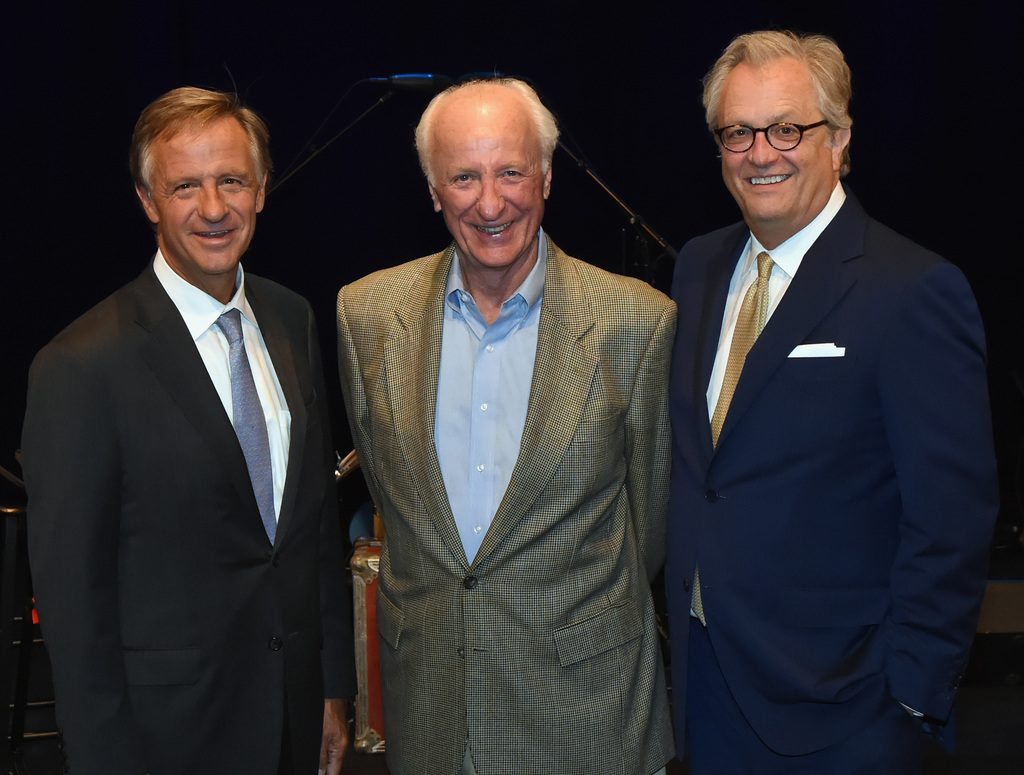
Pictured (L-R): Governor Haslam, Bob McDill, and Country Music Hall of Fame and Museum CEO Kyle Young

In the quest to expand on the museum’s archives, Tate and her team regularly visit with artists, songwriters, industry members, as well as families and estates of artists, seeking new items to be cataloged and archived.

“We are the most careful movers in town and we are free,” Tate says. “We go in with white gloves and pick though delicate items. We always respect that someone has let us in their homes and that they are letting us handle their history. Historically-savvy industry members will come to us and say, ‘I’m closing this office and we are moving. Come and look through our documents and files and see what the Country Music Hall of Fame and Museum needs.”

Once items are brought back to the Country Music Hall of Fame and Museum, they are cataloged and photographed, and meticulously maintained. The Country Music Hall of Fame and Museum’s 43,000 square feet of dedicated archival storage includes space for digitizing older documents, and a luthier shop for maintaining musical instruments.

“We spend a lot of time and resources collecting born digital items and converting them to make sure the data doesn’t become corrupt,” Tate says.

Tate says it is not only imperative for artists, but for publishers, publicists, performing rights organizations, recording studios, radio stations, labels, management companies, talent agencies and more to donate items and correspondence to help preserve the history of country music.

In the digital age, it is not only written lyrics that are increasingly important, but the myriad of documents that are now routinely sent electronically, which chronicle the industry’s history—press releases, calendars, set lists, day sheets, recording studio time logs, contracts, publishing and/or royalty statements and more. Items that seem mundane in the light of day-to-day operations for most music industry members, including datebooks, calendars, tour itineraries, set lists and journals, can prove invaluable in documenting where the industry was and what was happening at any point in an artist’s career.

“Things that seem out dated now are an incredibly important look back at that time in history,” Tate says. “We have a diary here Janie Fricke’s, before she got her own record deal. She was doing demos, so she would be singing for Coca-Cola in the morning and then she would be cutting her own songs in the afternoon. The variety of her sessions with singers and musicians in town is huge because it speaks to that incredible breadth of work that make up Nashville.”

Kix Brooks

“When I first got to town, the Hall of Fame was one of the first places I went,” recalls Brooks. “And it was exciting to see all those things and the way they had been kept. After decades in a duo, you collect so much stuff. We bought a warehouse to keep this stuff in, and we called the Hall of Fame and said, ‘My kids don’t want all this stuff. We are getting to the point of what do we do with it?’ It’s exciting that they really do care about it, and humbling that memorabilia like the awards, or those envelopes that had your name on them when you opened them, are valuable.”

“If you are managing an artist, you could be thinking about everything that is going out on your artist or if it is their first arena tour or first opening slot for a superstar,” Tate says. “Everybody is in the business of music should be documenting those moments. Bring those to us.”

Tate notes Sony Music Nashville’s Luke Combs and his team as one recent example of those forward-thinking organizations. Tate recalls that in commemorating Combs’ first No. 1 party celebrating “Hurricane,” his team gave the Country Music Hall of Fame and Museum a shirt from his first music video.

“That was a great idea,” Tate says. “You can bet that his early career is documented at the Hall of Fame now, and it was as easy as them being gracious enough to say, ‘This is important to be mentioned,’ and to be given the artifacts.”

Items such as those from Combs and Fricke are essential, personal mementos that enrich the story of country music because they document some of the earliest moments from an artist’s career.

“They are not all Gold records or awards, but they are precious to the history of country music,” Tate says.

To donate digital items to the Country Music Hall of Fame and Museum, email: archives@countrymusichalloffame.org

The Country Music Hall of Fame and Museum offers the following examples of items that can be important to maintain throughout an artist’s career, to preserve a legacy for future generations of country music fans:

Clothing: stage wear, including accessories (boots, jewelry, belts, hats, ties, etc.) or items of personal clothing that have significance, as well as clothing worn at awards shows, live performances, and in music videos.
Musical instruments, especially instruments an artist or writer learned to play on, or used to write songs, record, and perform with. The Museum is particularly interested in instruments with connections to specific performances or events in an artist’s life and career.
Awards: CMA, ACM, Grammy, and other industry trophies, plaques, certificates, etc.
Song manuscripts and objects used in the songwriting process, especially handwritten lyrics, including snatches of lyrics to unfinished songs, which help document the creative process.
Photographs: candid photos, from baby pictures and family photos, to the present.
Audio Recordings: studio demos, home recordings, live performances, rehearsal tapes, songwriter work tapes/demos, etc.
Film/Video: Professionally-produced footage of live performances, interviews, music videos, etc. (the Museum can accept most formats, but prefers Quicktime). Home Movies and Video
Personal and business correspondence, including fan mail
Business Documents: these include contracts, lead sheets, publishing and royalty statements.
Gifts/mementos from fans. Datebooks, Calendars, Journals, Tour Itineraries, Set Lists
Born Digital Items: music, documents, calendars, web presence only publications
Obsolete Media: floppy discs, hard discs, zip drives, Cyquest drives, Photo prints/negatives
Correspondence/notes/cards

George Strait, Chris Stapleton, Toby Keith, Lee Ann Womack Pay Homage To Jerry Lee Lewis

Jerry Lee Lewis, Lee Ann Womack, Chris Stapleton, Toby Keith, Kris Kristofferson, Waylon Payne, and George Strait perform onstage during Skyville Live Presents a Tribute to Jerry Lee Lewis on August 24, 2017 in Nashville, Tennessee. Photo: Rick Diamond/Getty Images for Skyville

I’m Real Nervous But It Sure Is Fun, goes a line from Jerry Lee Lewis’ signature 1957 hit “Great Balls Of Fire.”

The sentiment could have been shared by nearly every artist who took the stage at Nashville’s Skyville Live on Thursday night (Aug. 24) who paid homage to rock ‘n’ roll pioneer Jerry Lee Lewis. Artists like George Strait, Toby Keith, Kris Kristofferson, Lee Ann Womack, The McCrary Sisters, Chris Stapleton and Waylon Payne mentioned the honor, and nerves, that comes with performing before an iconic entertainer with more than six decades of recording and entertaining under his belt.

Flanked by a band of ace musicians the headliners paid tribute to Lewis, performing several of his biggest hits.

Skyville Live’s Wally Wilson noted each of the evening’s performers could have filled the Bridgestone Arena. Instead, he said, they jumped at the chance to perform for Lewis in Skyville Live’s intimate performance venue. Womack was said to have even canceled a personal appearance to be part of the show.

George Strait performs onstage during Skyville Live Presents a Tribute to Jerry Lee Lewis on August 24, 2017 in Nashville, Tennessee. Photo: Rick Diamond/Getty Images for Skyville

Strait opened the show with Lewis’ signature “Great Balls of Fire,” followed by “Middle Aged Crazy.” The “King of Country” clearly enjoyed every minute.

“He is a member of the Rock ‘N’ Roll Hall of Fame,” noted Toby Keith, who then offered a convicted rendition of “39 and Holding,” and wrapped his burly voice around the classic “Chantilly Lace.” “He should be in the Country Music Hall of Fame,” endorsed Keith. “You have no idea how good a country singer he is.”

One of the evening’s most soulful moments came courtesy of Stapleton and vocal quartet The McCrary Sisters, on the stirring gospel number “I’ll Follow Him.”

Kris Kristofferson’s performance revealed the Skyville Live producers only had asked him to record a message for Lewis. Instead, he offered to perform on the show. Kristofferson’s world-weathered voice was sturdy on the clever “Mean Old Man.”

Lee Ann Womack’s voice was smoky and silky on “What Made Milwaukee Famous.” She then traded earthy for ethereal textures on “She Even Woke Me Up To Say Goodbye,” noting it as one of her favorite Jerry Lee Lewis songs.

“I love your singing,” she told Lewis. “I like to think I learned a little from you, or at least I tried.”

Chris Stapleton (L) and Alfreda McCrary, Regina McCrary, Deborah McCrary, and Ann McCrary of The McCrary Sisters perform onstage during Skyville Live Presents a Tribute to Jerry Lee Lewis on August 24, 2017 in Nashville, Tennessee. Photo: Rick Diamond/Getty Images for Skyville

One of the evening’s highlights came from Waylon Payne, who portrayed “The Killer” himself in the 2005 Johnny Cash biopic Walk The Line. His voice was polished and soulful on “Who Will The Next Fool Be.”

“I wasn’t expecting this,” Lewis said as the hour-long show neared its conclusion, and the crowd offered him a standing ovation. Lewis sat at his stately piano, leading an all-star performance of “Whole Lotta Shakin’ Goin’ On.” At 81, Lewis proved his piano prowess is still as keen and lively as ever.

“This is some of the best music I’ve ever heard in my life,” Lewis said. “I’ll never forget this.”

Neither will anyone else in proximity to Skyville Live that evening—both onstage and off.

Lee Ann Womack performs onstage during Skyville Live Presents a Tribute to Jerry Lee Lewis on August 24, 2017 in Nashville, Tennessee. Photo: Rick Diamond/Getty Images for Skyville

Kris Kristofferson performs onstage during Skyville Live Presents a Tribute to Jerry Lee Lewis on August 24, 2017 in Nashville, Tennessee. Photo: Rick Diamond/Getty Images for Skyville

Jerry Lee Lewis performs onstage during Skyville Live Presents a Tribute to Jerry Lee Lewis on August 24, 2017 in Nashville, Tennessee. Photo: Rick Diamond/Getty Images for Skyville

Toby Keith performs onstage during Skyville Live Presents a Tribute to Jerry Lee Lewis on August 24, 2017 in Nashville, Tennessee. Photo: Rick Diamond/Getty Images for Skyville

George Strait performs onstage during Skyville Live Presents a Tribute to Jerry Lee Lewis on August 24, 2017 in Nashville, Tennessee. Photo: Rick Diamond/Getty Images for Skyville

Pictured (L-R): Kris Kristofferson, creator of Skyville Live Wally Wilson, Jerry Lee Lewis, Waylon Payne, and Toby Keith attend Skyville Live Presents a Tribute to Jerry Lee Lewis on August 24, 2017 in Nashville, Tennessee. Photo: Rick Diamond/Getty Images for Skyville

Kris Kristofferson performs onstage during Skyville Live Presents a Tribute to Jerry Lee Lewis on August 24, 2017 in Nashville, Tennessee. Photo: Rick Diamond/Getty Images for Skyville

ACM Honors Show Shines With Stars

George Strait performs onstage during the 11th Annual ACM Honors at the Ryman Auditorium on August 23, 2017 in Nashville, Tennessee. Photo: Terry Wyatt/Getty Images for ACM

This year’s Academy of Country Music “Honors” event was the most star-studded in the organization’s history.

Staged at the Ryman Auditorium on Wednesday evening (Aug. 23), the 2017 edition of this annual show featured appearances by superstars Alan Jackson, Dolly Parton, George Strait, Reba McEntire, Toby Keith and Brad Paisley, as well as a bevy of younger hit makers. This was the 11th ACM Honors presentation.

“Tonight’s honorees are so iconic, they only need one name – Reba, Toby, Dolly and George,” said Maren Morris, who introduced the show with Thomas Rhett.

McEntire was presented with a Mae Boren Axton Award for outstanding service to the ACM. Hillary Scott sang “The Night the Lights Went Out in Georgia” to salute the Hall of Famer. Scott then teamed with Karen Fairchild on “Does He Love You,” which McEntire originally sang with Scott’s mother, Linda Davis. Then Kimberly Schlapman sang lead on “Little Rock” with Scott and Fairchild providing trio harmonies on the chorus.

“The Academy of Country Music has been so sweet to me,” said McEntire. “For you girls, my buddies, to sing my songs, that meant so much to me. Mae has always been my guardian angel. I miss her so much. And I’m so proud to be getting this award with her name on it.”

Alan Jackson performs onstage during the 11th Annual ACM Honors at the Ryman Auditorium on August 23, 2017 in Nashville, Tennessee. Photo: Terry Wyatt/Getty Images for ACM

“There are few artists who manage to write their own legacies,” said Jimmy Webb in saluting Keith. “He’s a master songwriter.” Webb presented the star with a Poet’s Award.

“I was a songwriter before I was an artist,” said Toby Keith. When the ‘artist’ is done, I will still be a songwriter. And I want to thank God for letting me be a songwriter.”

Keith then rocked and roared through “Should’ve Been a Cowboy” and “Who’s Your Daddy,” demonstrating that his vocal power is the equal of his composing gifts.

Lady Antebellum presented the Gene Weed Milestone Award to Kelsea Ballerini for scoring No. 1 records with her first three singles.

“When I moved to Nashville, I was 15,” Ballerini recalled. “I didn’t know how to start. I watched music videos. I looked at the end for the names of the songwriters.

“Thank you, Nashville, for being so nice to me. And thank you, ACMs.” Ballerini sang her new hit “Legends,” plus a medley of her milestone makers “Love Me Like You Mean It,” “Dibs” and “Peter Pan.”

Maren Morris performs onstage during the 11th Annual ACM Honors at the Ryman Auditorium on August 23, 2017 in Nashville, Tennessee. Photo: Terry Wyatt/Getty Images for ACM

Chris Janson presented a second Poet’s Award to the late Shel Silverstein (1930-1999). “He ignited my creativity, like he’s done for so many writers,” said Janson.

He flew through Silverstein’s “A Boy Named Sue” in double time, then rocked “The Cover of Rolling Stone” with boundless stage energy and hot harmonica work. Janson drew a standing ovation, one of many that evening.

Susan Nadler accepted on behalf of her old friend: “His presence is still so strong, I dream about him once a month,” she said. “Shel was an original and an originator. And I wish we had more like him today.”

Paisley noted that we usually honor Parton for her songs. “Tonight, it’s her heart we’re celebrating. If you’re ever in need, there’s no better friend than Dolly Parton. She knows how to speak to people in their happiest day or in their darkest moment.”

Singer-songwriter Chris Stapleton performs onstage during the 11th Annual ACM Honors at the Ryman Auditorium on August 23, 2017 in Nashville, Tennessee. Photo: Terry Wyatt/Getty Images for ACM

Paisley sang “My Tennessee Mountain Home” in her honor. Parton was given the Gary Haber Lifting Lives Award for her Imagination Library literacy program and for coming to the aid of people in the wake of the East Tennessee wildfires this year.

“I’m blessed to be in a position to help inspire kids and to help victims of the fire to see a better and a brighter day,” said Parton. “The best way you can help us now is to come back to the Smokies. We’re open for business.”

The digital version of her debut children’s album, I Believe In You, comes out this week. Proceeds will go to the Dollywood Foundation.

Maren Morris and Kelsea Ballerini co-hosted a non-ACM segment, “XQ Super School Live.” Hume Fogg High School students were brought in to be the audience for Hunter Hayes as he sang “The Best In You” to and for them. This performance will become part of a special which will air, commercial free, on all of the networks Sept. 8.

Kimberly Schlapman, Jimi Westbrook, Karen Fairchild, and Phillip Sweet of Little Big Town perform onstage during the 11th Annual ACM Honors at the Ryman Auditorium on August 23, 2017 in Nashville, Tennessee. Photo: Terry Wyatt/Getty Images for ACM

Back to the ACM’s business at hand, Cassadee Pope presented the Tex Ritter Award to the CMT-TV series Nashville. The show’s stars Charles Esten and Clare Bowen sang its soundtrack song “Sanctuary.”

Executive producer Steve Buchanan accepted, saying, “Keeping this show real and honest has always been our goal. We do this because we love music and we love this city.”

A Glen Campbell Tribute segment was introduced by Morris singing “Galveston.” A video of last year’s ACM Honors show followed, featuring Blake Shelton (“Southern Nights”), Dierks Bentley (“Gentle On My Mind”), Keith Urban (“Wichita Lineman”) and Toby Keith (“By the Time I Get to Phoenix”).

Bobby Bones presented a Mae Boren Axton Award to Bob Kingsley, who is the ACM’s longest serving board member. He first joined the board in 1967. Thomas Rhett sang “Die a Happy Man” and “Craving You” for the honoree.

Bob Kingsley accepts the Mae Boren Acton Award onstage during the 11th Annual ACM Honors at the Ryman Auditorium on August 23, 2017 in Nashville, Tennessee. Photo: Terry Wyatt/Getty Images for ACM

“To receive this award gives me a chance to express my love and appreciation for the people who’ve contributed to the ACM down through the years,” said Kingsley.

Ross Copperman presented the Songwriter of the Year award to Lori McKenna, who penned this year’s so memorable “Humble and Kind.” Little Big Town (for whom she co-wrote “Girl Crush”) sang a soulful rendition of their current “When Someone Stops Loving You,” which she also co-wrote.

“It’s such an honor to be part of this,” said McKenna. “The thing about songwriters is, we don’t define ourselves by gender or race or anything else. We just call ourselves songwriters. Thank you to Nashville for accepting me as a Bostonian who writes country songs.”

Jason Aldean presented the Cliffie Stone Icon Award to George Strait. To salute the superstar, Chris Stapleton offered “When Did You Stop Loving Me” and Alan Jackson sang “Marina Del Ray” and “The Fireman.”

CMT’s Nashville wins the Tex Ritter Film Award during the 11th Annual ACM Honors at the Ryman Auditorium on August 23, 2017 in Nashville, Tennessee. Photo: Terry Wyatt/Getty Images for ACM

“When I first started out on the road, I thought I had maybe five years to sing my songs,” reflected Strait. “Well, now it’s been 30 years, and I still love it. I’ve been with the same record company my whole career. I signed with them in 1980, and I’ve been here longer than any of ‘em.”

He drew wild applause when he sang “Here for a Good Time” as the evening’s finale. The ACM Honors show will air as a CBS special on Sept. 12.

Brett Young hosted the pre-telecast honors. During the Studio Recording Awards, Glenn Worf (bass) and Jay Joyce (producer) were absent. Accepting were Dan Dugmore (steel/specialty instrument), Dave Cohen (keyboard), Miles McPherson (drums), Tom Bukovac (guitar), Chuck Ainlay (engineer) and Danny Rader (guitar).

Lori McKenna accepts the Songwriter of the Year honor at the ACM Honors in Nashville. Photo: Terry Wyatt/Getty Images for ACM

During the Industry Awards, Sally Williams (Ryman Auditorium), David Kells (Bridgestone Arena), Lenore Kinder (talent buyer), Ed Warm (promoter, Joe’s Live) and Chas Smith (The Joint at the Hard Rock Hotel & Casino in Las Vegas) were all attending winners. The also awarded Red Rocks Amphitheatre, Tortuga Music Festival and Foxwoods Resort & Casion had no representative present.

The house band and sound included Steve Hinson, Frank Liddell, Jeff King, Nick Buda, Charles Judge, Chip Matthews, Tim Marks and Carl Miner. The capacity Ryman audience included both fans and music-industry professionals. Videos of earlier ACM telecasts were screened during the brief set changes.

Singer-songwriter Thomas Rhett performs onstage during the 11th Annual ACM Honors at the Ryman Auditorium on August 23, 2017 in Nashville, Tennessee. Photo: Terry Wyatt/Getty Images for ACM

Reba McEntire, Dolly Parton and George Strait backstage at ACM Honors. Photo: Terry Wyatt/Getty Images for ACM

Brad Paisley and Dolly Parton backstage at ACM Honors. Photo: Terry Wyatt/Getty Images for ACM

Kelsea Ballerini and Brad Paisley backstage at 2017 ACM Honors. Photo: Terry Wyatt/Getty Images for ACM

Brett Young and Lady Antebellum’s Dave Haywood backstage at 2017 ACM Honors. Photo: Terry Wyatt/Getty Images for ACM

Warner Music Nashville’s Shane Tarleton Promoted To Sr. VP, Creative Services

Shane Tarleton

Warner Music Nashville has promoted Shane Tarleton from Vice President to Senior Vice President, Creative Services.

On his promotion WMN Chairman & CEO John Esposito said, “Shane offers so much more than just his extraordinary creative vision. He has established unparalleled relationships with our artists that allow him to identify and execute the individuality of each project. Shane gives not only of his time professionally, but also personally. He is heavily involved in philanthropic efforts throughout the industry with organizations like Musicians On Call. That kind of integrity and humanity is what this company is built on, and Shane is an example of the kind of long-term future we plan to have here at Warner Music Nashville.”

Tarleton will continue to drive Warner Music Nashville’s creative efforts by helping conceptualize the vision of each artist and the needs of the label, in addition to guiding the team tasked with its execution.

Tarleton said, “Espo has built a family here at WMN and I am proud to be a part of it. I have a deep love and appreciation for the art that we collectively get to create, and I look forward to many, many new successes!”

Tarleton began his career at Titley / Spalding Artist Management, after which he spent six years in the art department at RCA Label Group working on imaging and branding for country music superstars including Kenny Chesney, Brad Paisley and Martina McBride. Following a stint in Las Vegas producing events for MGM properties, Tarleton joined Warner Music Nashville as Creative Director in 2010.

Industry Honors Loretta Lynn At Hall Of Fame Exhibit Preview

Pictured (L-R): Peggy Lynn, Country Music Hall of Fame and Museum CEO Kyle Young, Margo Price, Brandy Clark, Patsy Lynn Russell and Kacey Musgraves. Photo: Rick Diamond for CMHoF

In nearly six decades of performing and recording music, Loretta Lynn has become many things.

The first female Entertainer of the Year honoree from the Country Music Association (1972).

A member of both the Country Music Hall of Fame and the Songwriters Hall of Fame.

A singer-songwriter who has earned four Grammys and sold more than 45 million albums.

A Presidential Medal of Freedom honoree.

A singer and/or songwriter behind hits including “Coal Miner’s Daughter,” “One’s On The Way,” “Fist City,” and more.

And above all, an inspiration for female artists who demand the creative freedom to make music their own way, write songs from a progressive perspective, as well as an example of the grit and talent required to rise from humble Kentucky roots to become a music icon.

Lynn was honored Tuesday night (Aug. 22) as those accomplishments took center stage at the Country Music Hall of Fame and Museum as the organization previewed the upcoming exhibit Loretta Lynn: Blue Kentucky Girl.

Modern troubadours, singer-songwriters who have borrowed from Lynn’s template of framing intelligent, unvarnished perspectives with bold, vivid lyrics and simple song constructs spoke and performed in tribute to Lynn.

Pictured (L-R): Brandy Clark, Kacey Musgraves, and Margo Price view the Loretta Lynn: Blue Kentucky Girl exhibit at Country Music Hall of Fame and Museum on August 22, 2017 in Nashville, Tennessee. (Photo by Rick Diamond/Getty Images for Country Music Hall Of Fame & Museum)

Brandy Clark offered a rendition of “Coal Miner’s Daughter,” while Margo Price offered “Fist City.”

Country Music Hall of Fame CEO Kyle Young recalled reaching out to Kacey Musgraves to pen the forward for an upcoming book based on the Lynn exhibit. It took Musgraves only two days to send in her thoughts, and she was on hand at the exhibit’s opening to share those thoughts.

“She’s probably had more songs banned than anyone in the country music business,” said Musgraves, referring to more controversial material from Lynn’s catalog, such as 1972’s “Rated X” and 1975’s “The Pill.”

“This is proof that when anyone in the music business chooses to stay within known successful lanes, avoiding creative risks and watering down content for ease of consumption in hopes of financial gain, they are not only damaging themselves but they are definitely damaging the rest of us, too.

“I can say that I would not be living the musical life as I know it without her example to follow,” Musgraves said. “When I think of the comments, reactions, and situations that I’ve been exposed to as a female artist in modern-day country music, I can only begin to imagine the odessey that she’s been on herself.”

Margo Price performs during the exhibition opening of Loretta Lynn: Blue Kentucky Girl at Country Music Hall of Fame and Museum on August 22, 2017 in Nashville, Tennessee. (Photo by Rick Diamond/Getty Images for Country Music Hall Of Fame & Museum)

Musgraves, herself known for sharp-witted, sometimes cynical songs such as her breakthrough, Grammy-winning tune “Merry Go ‘Round” and the CMA Award-winning “Follow Your Arrow,” says she took to heart Lynn’s boldness to write from her own perspective, regardless of what was popular on radio.

“When I sit down to write a song, the only compass I know to use is if an idea or a line makes me feel something, and I found that when you stick to speaking whatever truth you hold inside yourself, you will always end up connecting to others, whether you are from Butcher Holler, Kentucky, Berlin, or Holden, Texas. Songs like Loretta’s will stand the test of time, because at the core, they are all of us and we all crave to be heard.”

Loretta Lynn: Blue Kentucky Girl chronicles Lynn’s 50-plus years in the country music industry, and will include her handwritten manuscript for the 1970 hit “Coal Miner’s Daughter,” along with the American DR-332 ribbon microphone used during her first recording session at Western Recorders Studio in Los Angeles in 1960. That session would yield her first single, “I’m A Honky Tonk Girl.”

A view of the Loretta Lynn: Blue Kentucky Girl exhibit at the Country Music Hall of Fame and Museum on August 22, 2017 in Nashville, Tennessee. (Photo by Rick Diamond/Getty Images for Country Music Hall Of Fame & Museum)

Numerous dresses are on display, including the green chiffon gown Lynn wore to the 1972 CMA Awards, where she was named Entertainer of the Year. The red dress Lynn wore on the cover of her 1968 album Fist City, will also be included in the exhibit, as will the 1956 model 99 Singer sewing machine Lynn used to make her own stage clothes early in her career.

The Presidential Medal of Freedom, presented to Lynn by President Obama in 2013, will also be on display.

Lynn was not in attendance at the media preview, having suffered a stroke on May 5. Her daughter Patsy Lynn Russell offered a few words on her behalf.

“It was devastating for all of us because she’s such a strong woman,” Patsy said of her mother’s stroke. “She is still that strong woman. People from Sony Legacy came over to see her, and are plotting out the new record release and when she can come see the exhibit here at the Hall of Fame. It’s like, ‘Wow you don’t stop, do you?’ She’s doing so well. My mom doesn’t do anything without doing it 100 percent. When she came into this business she said, ‘You have to be first, great or different.’ She is all of those things wrapped into one.”

Patsy also emphasized that her mother will be back.

Brandy Clark performs Coal Miner’s Daughter onstage during the exhibition opening of Loretta Lynn: Blue Kentucky Girl at Country Music Hall of Fame and Museum on August 22, 2017 in Nashville, Tennessee. (Photo by Rick Diamond/Getty Images for Country Music Hall Of Fame & Museum)

Patsy said of the exhibit, “About a year ago, Mike Vaden came to me and said, ‘Kyle wants to talk to you about an exhibit at the Hall of Fame for your mom.’ For those of us on the outside, you don’t realize how much work goes into what this establishment does for these artists. To watch them build this exhibit from the ground up is an amazing blessing.”

Young perhaps summed the exhibit best, saying, “When you are looking at it, you are looking at country.”

Loretta Lynn: Blue Kentucky Girl opens at the Country Music Hall of Fame on Aug. 25 and runs through Aug. 5, 2018.

Bonus Q&A: PR Tips From Jake Basden, Ebie McFarland, Kristie Sloan, Jensen Sussman

For the 2017 Artist Roster print magazine, MusicRow exclusively sat down with public relations representatives behind artists including Taylor Swift, Florida Georgia Line, Kenny Chesney, George Strait, The Robertson Family, Ronnie Dunn, Eric Church, Jason Aldean, Bobby Bones, Dierks Bentley, Kelsea Ballerini and Dustin Lynch to discuss PR damage control in the modern age.

Jake Basden, VP Publicity & Corporate Communications, Big Machine Label Group; Ebie McFarland, Publicist/Owner, Essential Broadcast Media; Kristie Sloan, co-owner of the Greenroom and Jensen Sussman, Pres./Owner of Sweet Talk Publicity discuss their experiences with media in a world where clicks are driven with shock and awe, and consumers have devoured many celebrities after their missteps; think: Paula Deen or Kathy Griffin.

The full interview can be found in MusicRow’s latest Artist Roster Print magazine, available with a subscription. We exclusively discuss country music fan demographics—with identities being both Republicans and Democrats, LGBT and conservative Christian or even advocates for Blue Lives Matter and Black Lives Matter. The print feature also discusses how each publicist’s personal reactions have been neutralized to navigate crisis situations.

What follows is a bonus Q&A, which features the publicist’s advice for operating their businesses in today’s environment. Read the exclusive print interview in MusicRow’s 2017 Artist Roster Print magazine, available with MusicRow subscriptions and individually at musicrow.com.

– – –

MusicRow: How can a publicist get their voice heard when pitching for features?

Jake Basden: Rule one is: Know you’re audience. We’re really in the business of telling stories. MusicRow may be perfect for certain things that no one over at People magazine ever may need to see. You have to understand the goal and who you are trying to reach, because a lot of times trying to reach everyone will get you no one.

Kristie Sloan: I love a “No.” Then I can tell you why that “No” doesn’t work. [laughs]. I crave information and if we can figure out why a certain pitch didn’t work, we can try something else. If it’s not a fit, then it’s not a fit—I’m not going to force anything. But if I believe so strongly it is a fit, I want to have a dialogue about it.

Ebie McFarland: There are certain times we will go to our core Nashville journalists, ones who have been championing the format for a long time, to soundboard some stories and say, “Help me find the timeliness here.” A lot of time we’ll postpone a story 8-10 months because it may need told when a single is peaking, not when a single is going for adds—or one of 50 reasons. I think that is why we are so fortunate as a format to have so many people that actually care about these artists in real ways.

Jensen Sussman: Email still doesn’t replace a phone call. PR is so much about relationships and trying to tell those stories. When you can have a dialogue on the phone or in person, you can really go in-depth about that story. I always encourage my team, if you’re not hearing back, you need to get on the phone or take them to coffee. Because a lot of those emails could be deleted if you picked up the phone to have one conversation.

MR: With your rosters, do you get one-on-one attention for national media too?

Basden: It’s so competitive. There’s one music booker at Fallon. There’s tons of publicists trying to reach her. You have to be selfless, thinking of it that way and remembering that part. [Most people at BMLG] are talking about competing against the other 50 people on the country chart. But that booker is looking at every genre…

Sussman: …every single chart, and actors and others non-music related. We were just looking at what we’re all fighting for, pitching for and up against with magazines in print. There’s how many major books? There’s 12 covers a year and six are Hollywood actresses.

MR: Say you’ve secured one of those high-profile features, do you ever then turn and have to sell that opportunity to your client or take responsibility for a potential misstep during the interview?

Sussman: I always say, we present opportunities putting together the strongest campaigns we can and presenting as many opportunities we think are good fits for our clients. That’s our job. But there is an entire team and so many other factors. But we focus on working the hardest in our area—doing the best we can.

McFarland: I would add to that, explaining why it’s a good opportunity [to] team members that perhaps haven’t had a story in the Wall Street Journal, Kickstarter campaign or a New York Times magazine piece. Those set the tone for an album. When you’re trying to emphasize the importance of those outlets, explain why the [placement] can help now and why we recommend it is helpful. Because that’s ultimately why we’re getting paid, is for our expertise.

MR: How might national, or international media operate differently than we do in Nashville?

Basden: One way it gets challenging is TV. We get so used to CMT correspondents and artists go out of town to an awards show in Vegas or LA or New York and they go to the carpet and can’t understand why a producer may not know their album came out, or the name of their current single. Artists may not realize the correspondent has just been hired for that day and just has a list of people they need to interview. Whereas someone in [Nashville] who stays up on that information day to day would know that. So you will get feedback from artists in that regard. Even the bookers. Sometimes you’ll have conversations, because we’re consuming MusicRow magazine or Country Aircheck and everything all day [in Nashville], they may not be. That’s a good reminder to keep feeding them with information…

McFarland: …and contextualizing it. When you’re dealing with people that don’t live and breathe the format, it’s important to show in layman’s terms how it’s relevant to them without it becoming a stats or sales story. You have to evoke emotion from the segment, and that has to start with the pitch. If that doesn’t happen, it is very unlikely that it will become a moving piece. That’s a very delicate process, and something you work years to hone in able to be able to craft pitches so they don’t isolate your artist as one particular thing in their mind. Because a lot of times, you’re growing that relationship with that person for the first time, especially with international.

MR: So is that the challenge of publicists, to translate sales stats to compelling stories?

Basden: It is important not to get caught up in stats, like Ebie said. Every day from the label there are new stats. There’s a new No. 1 every week and you can’t go in expecting these people in these other markets to follow the charts like we do. And quite frankly, sales stats are not always a story. They may show momentum, but being No. 1 is not the story. Unless it’s historic.

Sussman: On a human-interest level, what fans and media producers connect with is that story the artist is telling. It seems like a big sales story, but what’s going to connect with them, and for us to get that segment or placement is the story of what that particular artist has gone through or is telling with their music. That is what is going to let us bring that spotlight on them, and that’s how you fall in love with music is because it speaks to you, and what you’re going through. That’s why we’re all in this and why we want to tell those story.

McFarland: Think of discovering music as a child. If you heard a song you liked, the first thing you’d do is read the back of the vinyl or booklet. Think of the way people consume music today. A lot of times they’re Shazaming it or Googling it. We want to create the content so when people hear the music, they are able to go down the rabbit hole and fall more in love and connect more with the artist and their story. Back in the day it would have been you wanted your bio to tell everything with the hopes of starting the conversation.

MR: Jake, from a label perspective, do you ever suggest artists hire an independent publicist from outside of Nashville?

Basden: I get so mad if one of our artists sign with someone outside Nashville because they think that whatever reason they’re in L.A. that they may bring something more to the table. Most times it doesn’t end up working out that way.

Sussman: [laughs]

Basden: So if you’re going to hire an indie in country, that person needs to be on the ground in Nashville. Nashville publicists do a good job looking at the whole picture—digital and print. A lot of times these bigger firms are really doing nothing but booking television for people all the time. We talked a lot about country today, but I think people in other facets of entertainment are crazy for not engaging more with Nashville publicists. Any of these [publicists here today] could do a better job than someone who happens to be on the ground in New York or L.A. I really believe that.

McFarland: We all pay Jake. He’s our publicist. [Laughs]

Do ever feel a sense of competition between each other, not only competing for clients but features and spots?

Sussman: It’s funny, Kristie and I just had drinks the other night. We have such a community [in Nashville] that I don’t ever feel competitive. There’s so much music, so many great artists and all of us are doing such great work. I have so much respect for everyone in the room that if there was a crisis situation and needed to bounce ideas, I really feel like I could call anyone.

Sloan: If anything it’s a healthy competition. Because if someone lands a cover, we all know how hard that is. Or you get SNL. That’s huge!

Basden: Exactly. And you’re opening the door for the rest of [Nashville].

McFarland: But to Jake’s earlier point about New York or L.A., if the growth of Nashville helps to overcome some of the stereotypes about businesses based in Nashville being somehow at a disadvantage geographically, then I’m all for the growth.

Maybe that collaborative nature comes from feeling like in order for somebody in Nashville to win, somebody else in Nashville doesn’t have to lose.

Basden: Except maybe during the CMA Awards.

All: [laughs]

Pick up MusicRow’s latest Artist Roster Print magazine, exclusively discussing what it feels like when the pressure is on during a crisis situation, available with a subscription.