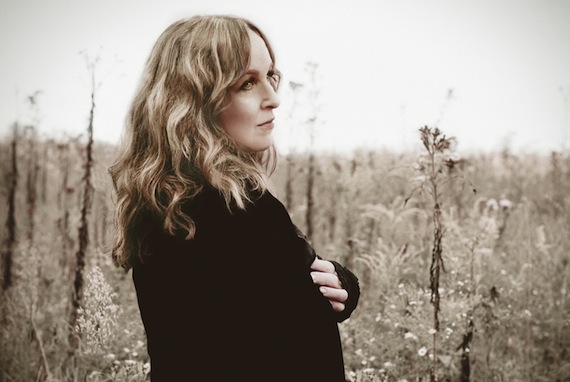
Two-time Grammy nominee Gretchen Peters appeared on The Producer’s Chair on Wednesday, Feb. 4, 2015 at Douglas Corner Cafe at 6 p.m.
By James Rea
In 2014 it became official…Gretchen Peters was inducted into the Nashville Songwriters Hall of Fame, re-confirming for those familiar with her music, her place among the greatest songwriters of our time.
In 1988 when she moved to Nashville with demos in hand, it didn’t take long for the industry to recognize her talent. She had been working since the age of 13 in Boulder, Col. Diving into music after her parents divorce, she honed her vocal chops singing covers, dissecting great songs and recording every chance she got.
“I started playing guitar when I was seven,” says Peters. “My parents sent me to an art camp which was heaven for a kid like me. I didn’t start writing until I was in my late teens. As weird as it sounds, the songs that I learned when I started playing guitar, seemed so elemental to me: Bob Dylan songs and Beatles songs and so forth. It didn’t even occur to me that I could write my own. They just seemed so big and important and part of the architecture of my world that I didn’t even think about writing my own songs until I started playing in bands and I saw that other people were doing original music. I could combine two things that I love—writing and music—by writing songs. I’d been writing other things my whole life: poetry, short stories, anything but songs, basically.”
Peters struck pay-dirt with her first publishing deal and then in 1991 began a 20-year run with Sony publishing. She recalls, “A wonderful man by the name of Noel Fox let me know that if I were serious about music and moved to Nashville he’d give me a publishing deal. He ran the Oak Ridge Boys’ publishing company which was called Silverline/Goldline. They had Steve Earle and Gail Davies—great roster. He and his wife became some of my best friends and he has since passed away. He was so important to me in terms of being someone who recognized that I didn’t fit in, in some ways. He recognized that I was very uncomfortable with co-writing and he gave me permission to not do it. He basically said, ‘I like what you do, and I like what you do alone even better. This isn’t a job where you come in and spend eight hours here. If you need to get in the car and drive to the beach go do that. Whatever you need to do to write, that’s what I want you to do.’ I’d never heard anything like that before.”
Her first cut, “Traveller’s Prayer,” was on George Jones’ duets album, with guests Sweethearts of The Rodeo. Within a year, Peters had cuts by Highway 101, whose drummer Cactus Moser had previously played with Peters in Colorado. She also scored the title cut on Randy Travis’ High Lonesome album, and when she had a No. 1 with George Strait recording “Chill of an Early Fall,” the flood gates opened.
She’s had over 120 cuts since, by renowned artists including Etta James, Pam Tillis, Trisha Yearwood, Anne Murray, Neil Diamond and The Neville Brothers. Bonnie Raitt recorded Peters’ “Rock Steady” which she co-wrote with Bryan Adams. In 1995, Gretchen received a Grammy nomination and CMA Song Of The Year Award for Martina McBride’s “Independence Day.” In 1996 she earned Grammy and ACM nominations for Patty Loveless’ “You Don’t Even Know Who I Am” and a “Nammy” (Nashville Music Award) for Best Songwriter. A 2003 Golden Globes nomination followed for her song “Here I Am,” from the DreamWorks film Spirit, Stallion of the Cimarron.
While touring incessantly, Peters has released seven studio albums of her own. The title track of her 1996 debut album The Secret of Life (Imprint Records) was a hit for Faith Hill. 2011 saw the release of the live DVD Wine, Women & Song with pals Suzy Bogguss and Matraca Berg.
Peters will be honored by the Country Music Hall of Fame and Museum’s Poets and Prophets discussion series on Jan. 24. Her Blackbirds CD release party will be Feb. 27 at the Franklin Theater, kicking off her run on the east coast and U.K. tour.
 The Producer’s Chair: How did it feel when you stepped on stage and started singing your own material for the first time?
Gretchen Peters: I loved singing covers, because I was singing music that I loved. I was doing songs by Rodney Crowelland Gram Parsons instead of the urban cowboy songs that were really popular. That’s probably why my band never did very well. But I noticed that people grew quiet when I sang my own songs and I was able to get their attention in a different way.
My band was a pretty hard rocking band. I didn’t really have the voice or songs to carry it off, but it was a good training ground for ten years. Even though the songs that I was writing were much more on the gentle, acoustic side and I was playing three or four of them a night in a club, I wasn’t really cultivating that side of my music yet. But I think both things were equally valuable—you’re learning the DNA of a great song.
When did you come to the conclusion that co-writing was not the answer, for you?
During a lot of those initial meetings, where I was trying to get people to listen to my songs, I heard two things a lot. Number one was, “You need to co-write.” Nobody ever really says why. They just say that you need to. The other thing that I heard was, “Do you want to be a singer or do you want to be a songwriter?” I heard equal opinions on either side as to which I should do. I was utterly baffled by that because to me every single artist that I loved was a singer and a songwriter. I wouldn’t have separated the two things in my mind in a million years. It’s like I always say—think about Paul Simon or Joni Mitchell. Are they singers or songwriters? Well, you can’t separate that. After a couple of fairly disastrous attempts at co-writing with people just because they were having some success, there was no organic reason to be in a room with them except that somebody sort of pushed me in that direction. I found that I just froze, because the way I naturally write feels like a very private act to me for the most part. Eventually I started having success with songs that I’d written by myself. That was validating.
When you signed with Sony you were about 35 years old. And you released your first album on Imprint in ’96 at 38. Did you ever have a sense at any point that you arrived too late?
I was aware of that, but there is something in me that refuses to ask permission. I felt like, “this is what I’m going to do and if you can help me, I welcome and appreciate your help, and if you can’t, get out of my way.”
When did you produce your first full-blown session?
I was producing long before I knew that’s what I was doing. Part of me thought that [professional] producers had secrets that I didn’t know, therefore I wasn’t a producer. It was a very slow development of my own confidence. And there’s an element of being a woman in the studio that was an extra obstacle. I remember one of my very first demo sessions, before I started playing guitar on my own demos. We had another guitar player because that’s what you did, you hired a full band and you got a guy who had perfect timing and played rhythm guitar perfectly. And he was dismissive of my abilities and I think he had a problem being told what to do, or even having suggestions made by a woman. It was quite unpleasant. In terms of technical skills, maybe I couldn’t keep perfect time and didn’t read charts as quickly, but I realized that by God, when I played guitar onmy own songs, the rest of the band members would follow my lead and the song ended up sounding more like me. So that’s when I took the bull by the horns, when I was in my mid-30s. But it wasn’t until I made the record Burnt Toast & Offerings that I felt like I owned my abilities.
Was there ever a time when you could see yourself producing other artists?
Yes, I remember hearing a singer/songwriter that I loved up in Canada, and having a gut-level, instinctive feeling that I could produce a really good album on this guy. And I would really love to do that. Unfortunately, that happened at about the same time as my touring career started taking off and I was releasing albums with much more frequency and the problem would be finding the time. For me it’s a lot like co-writing, in that it really has to be the right person.
When you demoed “Independence Day,” did you sing the demo?
I played it and sang it. The track was along the lines of Springsteen or Steve Earle with more of a straight-ahead rock feel. I had two cuts on that album by Martina, the other was “My Baby Loves Me.”
I sang all my own demos unless it was obviously a song for a man. It was very, very late in my career when somebody told me that male artists don’t like to listen to demos that are sung by females and that I should consider having a guy re-sing some of these songs. I was floored. A male artist can’t imagine singing a song, just because it’s being sung by a woman?
I think it’s evidence of my basic stubbornness. One of the main reasons I was singing my own demos was because, in my heart and soul and mind, I was practicing making records. It was an opportunity to be in the studio and see what you could make. I didn’t want to get into the assembly line of writing songs and then plugging-in the hot demo singer of the day, because it would rob me of an opportunity to go in there and learn something.
I’m not as prolific as a lot of people, in terms of my songwriting output. For the many years I was at Sony and many years before, I was writing 12 to 15 songs a year, but I was writing them all by myself, when a lot of people were writing 50 songs a year. But I had a high batting average. I edited myself to point where only the pretty good ones got out. So, of those 12 to 15 songs a year, I had a lot of success with many of them. There was a demo session where I did four songs and three of them became hits.
How do you get the best vocal performance out of yourself?
For me the most important thing is to get out of the way of the words. You can’t forget that you’re telling a story. When I’m performing live, my mantra is “let the song sing itself.” You can deliver a song in a whisper if you are focused on the lyrics. I think a lot of young singers who are gifted with great vocal ability have a hurdle to overcome in that they have to learn not to love the sound of their own voice, not to sing all the licks just because they can. The voice is a delivery system for the song. It’s a conduit to the emotion inside you.
Your husband/co-producer and longtime piano player Barry Walsh said, of his third solo effort, Silencio, “The whole idea for this recording was to find the space between the notes.” How has working with that level of musician affected your music?
His sense of space was what made me fall in love with his playing 25 years ago. I think he played on my second or third demo session around 1990, and I never called another piano player after that. He knew what NOT to play. And when we played together live, we had this intuitive, unspoken thing, where we would create a big hole and let the audience sort of fall into it—that’s the power of space. If you know when not to play, it draws people in. Our sense of dynamics together is one of our greatest strengths, and it’s not something you find with every musician you play with. We play together as if we’re breathing together. It’s magic.
What advice do you give to unsigned songwriters?
Young songwriters need someone to advocate for them, to encourage them to be themselves, to resist the urge to conform because they think that’s the way to success. I’m talking about artists here—not artists in the music business sense—but artists in the sense of people who make art. Those kind of songwriters. I don’t have any advice for people who want to write hits. For me it was an accident every single time. It was a by-product of my need to write. I want to encourage and advocate for young writers who are trying to achieve greatness beyond tallying up hits. Songs can be so much more than entertainment—there are songs that have literally changed my life. For the young writers who aspire to write those kind of songs, I say keep going, put your nose down, work hard and follow your instincts. Listen to great songs, and then listen to your gut.
Do you put pressure on yourself to write about subjects that haven’t been written about?
I try not to put any pressure on myself from an editorial point of view, when I’m in the beginning stages of writing. You can kill a song by over-intellectualizing it. And besides, there are always new ways to write about old subjects. Shakespeare supposedly said there are only seven stories. We’ve been telling those seven stories over and over again for thousands of years. The key is not to tell a new story but to tell your truth, which will always be someone else’s truth because we are all suffering from the same condition: humanity. The only pressure I put on myself is to let the song tell me what it wants to be. And to be honest—uncomfortably honest—if possible. I know when I’m onto something, because if it feels slightly uncomfortable that means I’m getting close to the bone.
“On A Bus to St. Cloud” has been cut by several artists. Have their interpretations unveiled emotions that you didn’t have when you wrote it?
I have that epiphany all the time with “On A Bus to St. Cloud.” Jimmy LaFave’s version was a revelation to me—the freedoms he took with the song, the emotional cast of it. I think that’s a measure of the quality of a song, how much you can discover within it and for how long. In the case of “St. Cloud”I have never gotten tired of singing it, even after 20 years. I still find new things in the lyric. Not all songs can stand up to that treatment. The best ones can.
How did you cultivate a U.K. fan base?
I started touring the U.K. after my first album came out in 1996. A friend of mine, who played with Nanci Griffith (who had a large following in the U.K. and Ireland), told me to go. He said, “they’ll get you.” And he was right. I was invited to come over by my record label there because my first album had done surprisingly well—unlike here in the U.S. I did about four shows, and I felt a connection with audiences there instantly. So I kept coming back. That was key. A lot of artists tour the U.K. and then don’t go back, and they wonder why they’re not playing bigger venues. But it’s a market unlike any other; you have to nurture it. I owe a great deal to the audiences in the U.K. because they sustained me at times when I had little else going on. They saw me the same way I saw myself: as a singer-songwriter. They didn’t care so much about the hits I’d written—although they were happy to hear those—as much as who I was as an artist. When Hello Cruel World came out in 2012, it did extremely well; we stepped up another level and started playing much bigger venues. That growth has continued with this upcoming tour. But you have to keep in mind this is probably my fifteenth or sixteenth U.K. tour.
What song have you yet to write, that has been haunting you the longest?
It’s very odd that you would ask because the day just passed. There’s a song that I have been writing for ten years called “The Last Day Of The Year” and for the last seven or eight years, I only look at it on New Year’s Eve. I pick it up on Dec. 31st and I work on it a little bit. One of these years it will be finished.
If you had it all to do over, what would you do differently?
There are things that I wish I had known earlier. I wish that I’d had more confidence in myself and my own convictions earlier and not thought that everybody knew more than I did. But in the end, I’m not so sure that really matters. There’s a certain amount of wisdom that I have that I couldn’t have acquired any other way.

The Producer’s Chair: Gretchen Peters
/by contributorTwo-time Grammy nominee Gretchen Peters appeared on The Producer’s Chair on Wednesday, Feb. 4, 2015 at Douglas Corner Cafe at 6 p.m.
By James Rea
In 2014 it became official…Gretchen Peters was inducted into the Nashville Songwriters Hall of Fame, re-confirming for those familiar with her music, her place among the greatest songwriters of our time.
In 1988 when she moved to Nashville with demos in hand, it didn’t take long for the industry to recognize her talent. She had been working since the age of 13 in Boulder, Col. Diving into music after her parents divorce, she honed her vocal chops singing covers, dissecting great songs and recording every chance she got.
“I started playing guitar when I was seven,” says Peters. “My parents sent me to an art camp which was heaven for a kid like me. I didn’t start writing until I was in my late teens. As weird as it sounds, the songs that I learned when I started playing guitar, seemed so elemental to me: Bob Dylan songs and Beatles songs and so forth. It didn’t even occur to me that I could write my own. They just seemed so big and important and part of the architecture of my world that I didn’t even think about writing my own songs until I started playing in bands and I saw that other people were doing original music. I could combine two things that I love—writing and music—by writing songs. I’d been writing other things my whole life: poetry, short stories, anything but songs, basically.”
Peters struck pay-dirt with her first publishing deal and then in 1991 began a 20-year run with Sony publishing. She recalls, “A wonderful man by the name of Noel Fox let me know that if I were serious about music and moved to Nashville he’d give me a publishing deal. He ran the Oak Ridge Boys’ publishing company which was called Silverline/Goldline. They had Steve Earle and Gail Davies—great roster. He and his wife became some of my best friends and he has since passed away. He was so important to me in terms of being someone who recognized that I didn’t fit in, in some ways. He recognized that I was very uncomfortable with co-writing and he gave me permission to not do it. He basically said, ‘I like what you do, and I like what you do alone even better. This isn’t a job where you come in and spend eight hours here. If you need to get in the car and drive to the beach go do that. Whatever you need to do to write, that’s what I want you to do.’ I’d never heard anything like that before.”
Her first cut, “Traveller’s Prayer,” was on George Jones’ duets album, with guests Sweethearts of The Rodeo. Within a year, Peters had cuts by Highway 101, whose drummer Cactus Moser had previously played with Peters in Colorado. She also scored the title cut on Randy Travis’ High Lonesome album, and when she had a No. 1 with George Strait recording “Chill of an Early Fall,” the flood gates opened.
She’s had over 120 cuts since, by renowned artists including Etta James, Pam Tillis, Trisha Yearwood, Anne Murray, Neil Diamond and The Neville Brothers. Bonnie Raitt recorded Peters’ “Rock Steady” which she co-wrote with Bryan Adams. In 1995, Gretchen received a Grammy nomination and CMA Song Of The Year Award for Martina McBride’s “Independence Day.” In 1996 she earned Grammy and ACM nominations for Patty Loveless’ “You Don’t Even Know Who I Am” and a “Nammy” (Nashville Music Award) for Best Songwriter. A 2003 Golden Globes nomination followed for her song “Here I Am,” from the DreamWorks film Spirit, Stallion of the Cimarron.
While touring incessantly, Peters has released seven studio albums of her own. The title track of her 1996 debut album The Secret of Life (Imprint Records) was a hit for Faith Hill. 2011 saw the release of the live DVD Wine, Women & Song with pals Suzy Bogguss and Matraca Berg.
Peters will be honored by the Country Music Hall of Fame and Museum’s Poets and Prophets discussion series on Jan. 24. Her Blackbirds CD release party will be Feb. 27 at the Franklin Theater, kicking off her run on the east coast and U.K. tour.
Gretchen Peters: I loved singing covers, because I was singing music that I loved. I was doing songs by Rodney Crowelland Gram Parsons instead of the urban cowboy songs that were really popular. That’s probably why my band never did very well. But I noticed that people grew quiet when I sang my own songs and I was able to get their attention in a different way.
My band was a pretty hard rocking band. I didn’t really have the voice or songs to carry it off, but it was a good training ground for ten years. Even though the songs that I was writing were much more on the gentle, acoustic side and I was playing three or four of them a night in a club, I wasn’t really cultivating that side of my music yet. But I think both things were equally valuable—you’re learning the DNA of a great song.
When did you come to the conclusion that co-writing was not the answer, for you?
During a lot of those initial meetings, where I was trying to get people to listen to my songs, I heard two things a lot. Number one was, “You need to co-write.” Nobody ever really says why. They just say that you need to. The other thing that I heard was, “Do you want to be a singer or do you want to be a songwriter?” I heard equal opinions on either side as to which I should do. I was utterly baffled by that because to me every single artist that I loved was a singer and a songwriter. I wouldn’t have separated the two things in my mind in a million years. It’s like I always say—think about Paul Simon or Joni Mitchell. Are they singers or songwriters? Well, you can’t separate that. After a couple of fairly disastrous attempts at co-writing with people just because they were having some success, there was no organic reason to be in a room with them except that somebody sort of pushed me in that direction. I found that I just froze, because the way I naturally write feels like a very private act to me for the most part. Eventually I started having success with songs that I’d written by myself. That was validating.
When you signed with Sony you were about 35 years old. And you released your first album on Imprint in ’96 at 38. Did you ever have a sense at any point that you arrived too late?
I was aware of that, but there is something in me that refuses to ask permission. I felt like, “this is what I’m going to do and if you can help me, I welcome and appreciate your help, and if you can’t, get out of my way.”
When did you produce your first full-blown session?
I was producing long before I knew that’s what I was doing. Part of me thought that [professional] producers had secrets that I didn’t know, therefore I wasn’t a producer. It was a very slow development of my own confidence. And there’s an element of being a woman in the studio that was an extra obstacle. I remember one of my very first demo sessions, before I started playing guitar on my own demos. We had another guitar player because that’s what you did, you hired a full band and you got a guy who had perfect timing and played rhythm guitar perfectly. And he was dismissive of my abilities and I think he had a problem being told what to do, or even having suggestions made by a woman. It was quite unpleasant. In terms of technical skills, maybe I couldn’t keep perfect time and didn’t read charts as quickly, but I realized that by God, when I played guitar onmy own songs, the rest of the band members would follow my lead and the song ended up sounding more like me. So that’s when I took the bull by the horns, when I was in my mid-30s. But it wasn’t until I made the record Burnt Toast & Offerings that I felt like I owned my abilities.
Was there ever a time when you could see yourself producing other artists?
Yes, I remember hearing a singer/songwriter that I loved up in Canada, and having a gut-level, instinctive feeling that I could produce a really good album on this guy. And I would really love to do that. Unfortunately, that happened at about the same time as my touring career started taking off and I was releasing albums with much more frequency and the problem would be finding the time. For me it’s a lot like co-writing, in that it really has to be the right person.
When you demoed “Independence Day,” did you sing the demo?
I played it and sang it. The track was along the lines of Springsteen or Steve Earle with more of a straight-ahead rock feel. I had two cuts on that album by Martina, the other was “My Baby Loves Me.”
I sang all my own demos unless it was obviously a song for a man. It was very, very late in my career when somebody told me that male artists don’t like to listen to demos that are sung by females and that I should consider having a guy re-sing some of these songs. I was floored. A male artist can’t imagine singing a song, just because it’s being sung by a woman?
I think it’s evidence of my basic stubbornness. One of the main reasons I was singing my own demos was because, in my heart and soul and mind, I was practicing making records. It was an opportunity to be in the studio and see what you could make. I didn’t want to get into the assembly line of writing songs and then plugging-in the hot demo singer of the day, because it would rob me of an opportunity to go in there and learn something.
I’m not as prolific as a lot of people, in terms of my songwriting output. For the many years I was at Sony and many years before, I was writing 12 to 15 songs a year, but I was writing them all by myself, when a lot of people were writing 50 songs a year. But I had a high batting average. I edited myself to point where only the pretty good ones got out. So, of those 12 to 15 songs a year, I had a lot of success with many of them. There was a demo session where I did four songs and three of them became hits.
How do you get the best vocal performance out of yourself?
For me the most important thing is to get out of the way of the words. You can’t forget that you’re telling a story. When I’m performing live, my mantra is “let the song sing itself.” You can deliver a song in a whisper if you are focused on the lyrics. I think a lot of young singers who are gifted with great vocal ability have a hurdle to overcome in that they have to learn not to love the sound of their own voice, not to sing all the licks just because they can. The voice is a delivery system for the song. It’s a conduit to the emotion inside you.
Your husband/co-producer and longtime piano player Barry Walsh said, of his third solo effort, Silencio, “The whole idea for this recording was to find the space between the notes.” How has working with that level of musician affected your music?
His sense of space was what made me fall in love with his playing 25 years ago. I think he played on my second or third demo session around 1990, and I never called another piano player after that. He knew what NOT to play. And when we played together live, we had this intuitive, unspoken thing, where we would create a big hole and let the audience sort of fall into it—that’s the power of space. If you know when not to play, it draws people in. Our sense of dynamics together is one of our greatest strengths, and it’s not something you find with every musician you play with. We play together as if we’re breathing together. It’s magic.
What advice do you give to unsigned songwriters?
Young songwriters need someone to advocate for them, to encourage them to be themselves, to resist the urge to conform because they think that’s the way to success. I’m talking about artists here—not artists in the music business sense—but artists in the sense of people who make art. Those kind of songwriters. I don’t have any advice for people who want to write hits. For me it was an accident every single time. It was a by-product of my need to write. I want to encourage and advocate for young writers who are trying to achieve greatness beyond tallying up hits. Songs can be so much more than entertainment—there are songs that have literally changed my life. For the young writers who aspire to write those kind of songs, I say keep going, put your nose down, work hard and follow your instincts. Listen to great songs, and then listen to your gut.
Do you put pressure on yourself to write about subjects that haven’t been written about?
I try not to put any pressure on myself from an editorial point of view, when I’m in the beginning stages of writing. You can kill a song by over-intellectualizing it. And besides, there are always new ways to write about old subjects. Shakespeare supposedly said there are only seven stories. We’ve been telling those seven stories over and over again for thousands of years. The key is not to tell a new story but to tell your truth, which will always be someone else’s truth because we are all suffering from the same condition: humanity. The only pressure I put on myself is to let the song tell me what it wants to be. And to be honest—uncomfortably honest—if possible. I know when I’m onto something, because if it feels slightly uncomfortable that means I’m getting close to the bone.
“On A Bus to St. Cloud” has been cut by several artists. Have their interpretations unveiled emotions that you didn’t have when you wrote it?
I have that epiphany all the time with “On A Bus to St. Cloud.” Jimmy LaFave’s version was a revelation to me—the freedoms he took with the song, the emotional cast of it. I think that’s a measure of the quality of a song, how much you can discover within it and for how long. In the case of “St. Cloud”I have never gotten tired of singing it, even after 20 years. I still find new things in the lyric. Not all songs can stand up to that treatment. The best ones can.
How did you cultivate a U.K. fan base?
I started touring the U.K. after my first album came out in 1996. A friend of mine, who played with Nanci Griffith (who had a large following in the U.K. and Ireland), told me to go. He said, “they’ll get you.” And he was right. I was invited to come over by my record label there because my first album had done surprisingly well—unlike here in the U.S. I did about four shows, and I felt a connection with audiences there instantly. So I kept coming back. That was key. A lot of artists tour the U.K. and then don’t go back, and they wonder why they’re not playing bigger venues. But it’s a market unlike any other; you have to nurture it. I owe a great deal to the audiences in the U.K. because they sustained me at times when I had little else going on. They saw me the same way I saw myself: as a singer-songwriter. They didn’t care so much about the hits I’d written—although they were happy to hear those—as much as who I was as an artist. When Hello Cruel World came out in 2012, it did extremely well; we stepped up another level and started playing much bigger venues. That growth has continued with this upcoming tour. But you have to keep in mind this is probably my fifteenth or sixteenth U.K. tour.
What song have you yet to write, that has been haunting you the longest?
It’s very odd that you would ask because the day just passed. There’s a song that I have been writing for ten years called “The Last Day Of The Year” and for the last seven or eight years, I only look at it on New Year’s Eve. I pick it up on Dec. 31st and I work on it a little bit. One of these years it will be finished.
If you had it all to do over, what would you do differently?
There are things that I wish I had known earlier. I wish that I’d had more confidence in myself and my own convictions earlier and not thought that everybody knew more than I did. But in the end, I’m not so sure that really matters. There’s a certain amount of wisdom that I have that I couldn’t have acquired any other way.
Belmont University Welcomes New Music Business Dean Doug Howard
/by Jessica NicholsonDoug Howard addresses the crowd during a welcome reception at Columbia Studio A.
Belmont University faculty and alumni, as well as many Nashville music industry luminaries, welcomed Belmont alumnus Doug Howard as the new dean of the Mike Curb College of Entertainment & Music Business during a reception held at Music Row’s historic Columbia Studio A on Wednesday, Jan. 21.
Belmont president Bob Fisher first addressed the audience, reminding them of Howard’s academic and music industry achievements. Howard earned his undergraduate degree from Belmont in 1979, and went on to earn his JD from George Washington University School of Law, and his MBA at Vanderbilt. Early on, Howard served as a song plugger and studio manager for Welk Music Group. Following law school, he served as VP/GM at Polygram, and later as Sr. VP of A&R at Lyric Street Records/Walt Disney Company. He recently founded Vandermont Music Group.
Howard fills a position held for nearly 10 years by Wes Bulla. Among those in attendance were Bulla, Belmont trustee and alumnus Mark Wright, the first dean of the Mike Curb College of Entertainment and Music Business Jim Van Hook, as well as Ricky Skaggs, Don Cusic, Harry Chapman, Sarah Cates, and James Elliott.
Howard mentioned the growth projections for the Curb College of Music Business & Entertainment department, including plans to reach into every aspect of entertainment, including film.
“This is really full-circle for me,” said Howard. “I was fortunate to meet some great mentors when I attended Belmont, including Robert Mulloy.”
It was noted that the department has seen incredible enrollment growth, from 600 students when the major first began, 2200 majors this year. He was also realistic about the current stage of the music industry and hopeful for its future. “The industry is struggling, but it is changing and our students will be helping to lead the charge,” said Howard.
Howard has maintained his Belmont ties through the years, serving as the chair of the Advisory Board of the Curb College and as a member of the William G. Hall Scholarship Committee. Additionally, he serves on the Advisory Council for the Center for Popular Music at Middle Tennessee State University, the Board of the Tennessee Shakespeare Festival and the Nashville Board of Governors of the Recording Academy.
Linda Edell Howard and Doug Howard
Ricky Skaggs and Doug Howard
Doug Howard, Linda Edell Howard, and Bob Fisher
Don Cusic and Doug Howard
The crowd gathers to honor Doug Howard.
Weekly Chart Report (1/23/15)
/by Troy_StephensonClick here or above to access MusicRow‘s weekly CountryBreakout Report
A-Squared Management Signs Marie Miller
/by Kelsey_GradyMarie Miller
Nashville-based A-Squared Management is proud to announce the signing of Curb Records artist Marie Miller to the roster.
Miller’s most recent single “6’2” charted at No. 26 on Billboard AC and the music video premiered on VH1 as well as receiving significant airplay on Sirius XM stations. Miller is currently working on her forthcoming full length album for Curb Records & will be represented for management by A-Squared Management Vice President Josh Terry.
“We are very excited to announce the signing of Marie Miller to our management roster and are thrilled to be partnering with Curb Records as she begins to work on her forthcoming full length album,” said Terry.
Miller will be performing a free show at The Basement in Nashville, TN on Feb. 9 at 7:30 p.m. to debut new material from her forthcoming album.
MusicRowPics: Old Dominion
/by Kelsey_GradyOld Dominion visit
Nashville quintet Old Dominion, which includes Matt Ramsey, Trevor Rosen, Whit Sellers, Geoff Sprung,and Brad Tursi, has seen some of its members’ names on the country radio charts as songwriters with hits recorded by Kenny Chesney, Keith Urban, The Band Perry (“Chainsaw”), Dierks Bentley (“Say You Do”), Tyler Farr (“A Guy Walks Into A Bar”), and others.
Now, with their independently released, self-titled EP, the members are getting a taste of working the radio charts as an artist. The EP, released in 2014, boasted production from top-shelf songwriter-producer Shane McAnally. McAnally earned a Grammy honor last year, alongside Luke Laird and Kacey Musgraves, for his work on Musgraves’ Same Trailer, Different Park project.
The quintet stopped by MusicRow’s office to showcase three songs, including “Roll Around With You,” “Shut Me Up,” and current single “Break Up With Him.” All members of the group had a hand in writing “Break Up With Him.” “I think that makes it even a little more special for us, to have this song as the first single,” says Rosen.
Thanks to early airplay on SiriusXM, “Break Up With Him” piqued the interest of radio programmers across the nation, and several stations began airing the album cut late last year. Responding to demand for the song, the band’s management is rushing out the radio single, with an official impact date of Feb. 9.
The quintet has landed an opening slot on Chesney’s upcoming The Big Revival Tour this summer. The gig makes them the first independent act to ever be part of a stadium tour.
“For months we kept joking about going on the road with him, and then they said, ‘Well now that the Kenny tour is happening…’ and we couldn’t believe it,” said Ramsey. Thus far, the band has primarily played smaller venues, including opening for Chase Rice’s Ignite The Night Tour. “There’s no way to really prepare for something like stadium dates. We are just excited to get out there and play our music.”
[slide]
RareSpark Signs Walker Hayes for Publishing
/by Eric T. ParkerPictured (L-R): Christian Barker (Founder/President, Capri Nashville), Walker Hayes, Suzanne Strickland (Owner/CEO, RareSpark), Lauren Spahn (Shackelford, Bowen, Zumwalt & Hayes), Scot Sherrod (VP/GM, RareSpark)
Singer-songwriter Walker Hayes has signed an exclusive world-wide music publishing contract with RareSpark Media Group.
“We feel so lucky to be able to partner with such an extremely talented and incredibly hard-working individual,” says RareSpark’s Owner/CEO Suzanne Strickland.
“Walker is a triple-threat,” continues RareSpark’s VP/GM Scot Sherrod. “He is an amazing artist, songwriter and producer. His artistry and songwriting as a whole is at its all-time best and we are very excited to work together to help bring it to the masses.”
Of the new partnership, Hayes’ manager Christian Barker remarks, “Throughout the process of finding a new publishing home for Walker, RareSpark stuck out as an innovative, team-oriented organization with which we are thrilled to partner.”
Previously signed to Capitol Nashville, the Alabama native moved to Nashville in 2005. He has found success in writing “Eat, Sleep, Love You, Repeat” for Rodney Atkins; “Joy Like Judy,” an anthem for The Bobby Bones Show; and Colt Ford‘s “Dirty Side.” Walker has also made an appearance on the TLC series 19 Kids & Counting, performing a song he wrote commemorating the engagement of Jill Duggar.
ACM Awards Announce Partnership With Mary Kay
/by Kelsey_GradyThroughout the awards show on Sunday, April 19, there will also be six Mary Kay commercials that air nationwide.
“The 50th ACM Awards is a landmark event and we’re thrilled to be part of a historical country music experience at one of the biggest venues in the country in our own backyard,” said Sara Friedman, Vice President of U.S. Marketing for Mary Kay Inc. “This platform allows us to showcase our irresistible beauty products to a national audience while providing an opportunity to engage Mary Kay’s independent sales force and reach Mary Kay brand lovers, as well as new customers, through a new and different avenue.”
The Doobie Brothers To Be Honored During Music Biz 2015
/by Jessica NicholsonPictured (L-R): John McFee, Tom Johnston, Patrick Simmons, and Michael McDonald of The Doobie Brothers
The Doobie Brothers will be honored with the Music Biz 2015 Chairman’s Award for Sustained Creative Achievement during its upcoming event in Nashville. The honor will be given during the Music Biz 2015 Awards Luncheon, set for Thursday, May 14 at 12 p.m.
“The Doobie Brothers have achieved incredible success over the years, selling an astonishing number of records and maintaining a regular presence on the Billboard charts,” said Fred Beteille, Chairman of Music Biz. “By re-envisioning their greatest hits through the filter of country music, the band has revealed new dimensions to songs that millions of people know by heart. I’m honored that they will be the recipient of my first Award as Chairman of Music Biz and am excited to celebrate the legacy of this band as they enter the next chapter of their career.”
“Receiving this Award is a great honor, as it recognizes the music from our early days together and shines a light on the music we’re creating right now,” said Tom Johnston of The Doobie Brothers. “We’re excited about the new creative doors we’ve opened up for ourselves by working with so many great Country musicians and can’t wait to carry that experience forward. A heartfelt thanks from the whole band to the Music Business Association for this amazing Award,” adds The Doobie Brothers member Patrick Simmons.
Previous recipients of the Music Biz Chairman’s Award include Paul Rodgers, Buddy Guy, Lionel Richie, Brian Wilson, Cyndi Lauper, Daryl Hall & John Oates, BB King, Chicago, Kool & The Gang, Carlos Santana, Liza Minnelli, Kenny Rogers, Dionne Warwick, Fleetwood Mac, Billy Joel, Stevie Wonder, Nat King Cole, Barbra Streisand, Judy Garland, and Frank Sinatra, among others.
Music Biz 2015, which will be held in Nashville for the first time in Association history on May 12-14, will give the commerce and content sectors a place to meet with trading partners, network with new companies, and learn about new trends and products impacting the music business. Registration is available now, with early bird discounts available until March 8. For more information or to sign up for the conference, visit musicbiz2015.com.
Music Collection Service Audiam To Hold Free Nashville Seminar
/by Jessica Nicholson“Songwriters, publishers and artists’ works are being used by technology companies to sell hardware, software, gain market share and/or generate billions of dollars via IPOs,” says Price. “However, the music copyright holders are not getting paid for the use of their music. And there is no better city in the world to discuss this issue than at the heart of the songwriter universe, Nashville, TN.”
Investors in the company include Jimmy Buffett, Jason Mraz, Bill Silva, Marc Geiger and GSO Business Group. It represents the publishing catalogs of Dolly Parton, Red Hot Chili Peppers, Trent Reznor, Graham Nash, Herbie Hancock, Tom Waits, Tori Amos, Aimee Mann, Pretty Lights, Puscifer and more.
The event will take place Friday, Jan. 30 from 11 a.m. until 2:30 p.m. at the Frist Lecture Hall at Belmont University’s Inman Center. Free parking is available on the first floor of the Belmont North Garage.
To RSVP, contact attend@audiam.com
Milom Horsnell Crow Rose Kelley Adds Associate
/by Sherod RobertsonShehan is a recent graduate of Belmont College of Law and received her BBA in Music Business from Belmont University, where she was a Copyright Society of the South scholarship recipient.
Her experience includes interning for the Nashville Music Council for two years under Co-Chairs Mayor Karl Dean and Mary Ann McCready, interning for Congressman Jim Cooper in Washington D.C., and working as a research assistant for Dr. Don Cusic at Belmont University.
Shehan also contributed to an editorial feature in MusicRow’s January 2015 Next Big Thing print issue. Molly can be reached at mshehan@milomlaw.com or (615) 255-6161.