Sony Goes To The Cloud With Music Unlimited

Have you found yourself thinking lately, “Hey, I wish there were more subscription-based music services available to me as a consumer?”

Right. We thought not.

But apparently no one notified Sony, who unveiled its Music Unlimited service in the U.K. and Ireland this week boasting a catalog of approximately 6 million titles from Universal Music, Warner Music, EMI Music and Sony Music. Sony has plans to expand the Music Unlimited to the U.S., Canada, Australia, New Zealand, France, Germany, Italy and Spain in 2011.

The service, powered by Sony’s Qriocity (pronounced: curiosity) entertainment platform, is being offered at two price levels. The basic plan, for £3.99 euros/month, is similar to an ad-free internet radio station but will allow users to skip forward at will (think Pandora or Last.fm). The premium version for £9.99 euros/month grants users the ability to play songs from the entire catalog on demand. Users at either level will also be able to sync info from their music libraries into the subscription cloud.

“So let’s see,” wrote Guardian authors Josh Halliday and Charles Arthur, putting some skepticism on the announcement. “Spotify with ads for free, or Sony MUPBQ for £3.99 every month for ever and ever?”

Perhaps the biggest draw is that Music Unlimited will be compatible with Sony’s array of consumer electronics. Internet-connected Blu-Ray players, Bravia television sets, and the Playstation 3 console will be able to use it, and so will Sony smart phones and computers. Smart phones running Google’s Android operating system will have an app that runs it, though it does not appear to be compatible with the iPhone at present.

As the LA Times points out, one major hurdle facing Sony and Music Unlimited is the fact that a myriad of similar products are already available in Europe and the U.S. Spotify (based in Sweden) has been a huge hit in Europe, largely due to it being a free, ad-supported service that works with multiple platforms. In the U.S., consumers have subscription options like Rhapsody, MOG, Rdio and more, all of which already work with numerous phone platforms including the iPhone.

Do Twitter Followers Equal Sales?

Billboard’s Antony Bruno does an excellent job peering under the hood at Soulja Boy’s recent Nov. 30 album release which managed to shift 13,000 units, a surprisingly modest debut considering the artist has 2.5 million Twitter followers. Does this mean that Twitter’s ability to influence and drive sales is becoming less important? What about for other formats like country music?

Bruno notes that Soulja Boy is more of a singles artist than most, however his last album project (2008) sold about 45k first week units. So he asks, “Soujla Boy has 2.5 million Twitter followers, but how many are paying attention? It’s pretty easy to tune out Twitter feeds you’re no longer interested in without going through the trouble of actually dropping the account you’re following.”

“It certainly seems like he did all the right things: compiled a massive Twitter following, kept them engaged with regular posts, and then issued a call to action several times a day with direct access to buy the album,” Bruno continues. “So why the disconnect between 2.5 million people making the effort to follow Soulja Boy on Twitter, but only 13,000 buying the album?”

Unfortunately, finding a solid answer is problematic. Because there are very few country music artists with over 500,000 Twitter followers it’s difficult to draw direct Nashville comparisons with the Soulja Boy parable. However, sales and celebrity do not seem inseparable in the country music arena, either. Billy Ray Cyrus, for example has 507,401 Twitter followers and engages fans with regular, if not prolific updates. Unfortunately, despite a legion of Twitter followers, Cyrus does not have an album listed in the current Top 200. Dolly Parton is the 2nd highest ranked on MusicRow’s country artist Twitter chart with 843,136 followers, but that has not translated into Top Ten CD sales for her either. Then there are artists like Taylor Swift (4.86 million Twitter followers), Kenny Chesney (604,160) and Lady Antebellum (224,556) whose sales continue to place them at the top of the charts despite regardless of having dramatically fewer followers than Soulja Boy.

If there is a conclusion to be drawn it might appear that making the decision to follow or friend someone can be based upon a wide variety factors that may not include purchasing the artist’s music. As marketing guru Seth Godin says, “The problem with browsers is that they rarely buy anything.”

Perhaps the next level of social network marketing will address finding ways to convert lookers to buyers, saying simply, “Quit looking and go buy something already.”

OMG, Email, WRU?

An article in the New York Times points out the growing divide between communication modes of people young and old. Not surprisingly, those in the younger bracket prefer real-time online chats and text messaging to traditional email. Actual phone calls have been on the decline for some time.

Younger people tend to prefer a more conversational and real-time flow in their digital communication, and therein lies the problem with email. The process of signing in, filling in subject lines, and having to possibly wait hours for a response, is too much formality for the younger demo. Unique visitors to web-based email services like Yahoo and Hotmail are in decline since their peak last year, and only Gmail has seen an increase in use.

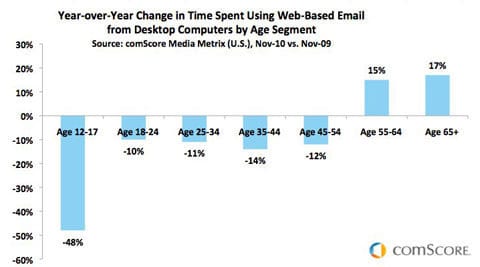
According to a related study, there has been a 48% decline among people 12-17 using web-based email services since Nov. 2009. Interestingly, the only demographic groups to show positive growth in use of web email in the same period are ages 55-64 and 65+.

Facebook is trying to address the issue by making its new messaging system more conversational, eliminating the subject line and CC/BCC fields altogether. Gmail has added chat and telephony to its array of services, which might explain some of its continued growth.

Overall it seems to be more of a shift than outright extinction for Email, as the article points out. Business people still rely on Email as the standard of communication in the workplace, and online shopping would be virtually impossible without it.

Country ’10 Sales Fall Short

Nielsen SoundScan handicappers are now melancholy with the realization that country will not achieve flat sales compared with 2009. With two 2010 sales weeks remaining—one leading into the holiday and one after, your Scribe is predicting that country album sales will total about 42.2 million units a drop of about 6.9% when compared with 2009 and adjusted for 52-week comparison. Overall music industry album sales remain down 13%.

Source: Nielsen SoundScan

The numbers are especially significant when considering that country labels and marketers threw everything they had into the 2010 season. Virtually every superstar and rising star found themselves on the release schedule—Taylor Swift, Rascal Flatts, Jason Aldean, Sugarland, Keith Urban, Kenny Chesney, Zac Brown Band, Tim McGraw, The Band Perry, Alan Jackson, Reba, Blake Shelton and more issued new and/or Greatest Hits packages in a mammoth effort to pry open holiday wallets. And it worked—but maybe not as well as one might have hoped. Especially when considering the boost when Taylor’s first week eclipsed expectations hitting the one million unit plus mark.

Speaking about Taylor, how do sales of Speak Now compare with Fearless? Answer: very well. Release to date (RTD) 8 week numbers show Speak Now with 2.607 million and Fearless (1/4/09) with 2.201 million. For the week ending 12/19/2010 Taylor Swift again rises to top all lists with about 259k units. On the country list she was miles in front, but on the all genre Top 200, Susan Boyle, who was No. 1 last week closely followed with over 254k units.

Spunky siblings The Band Perry remain atop the country genre tracks list, shifting over 4j7k additional copies this week of “If I Die Young.” Swift (39+), Chesney (38+), Sugarland (37+) and Aldean (31+) also sold in the over 30k range.

And now some year-end musings…(a good time to go to the kitchen for a snack if you don’t like to face the hard truth..)

[Editorial paragraph] The question waiting in the wings is what will happen in 2011? Will all the same artists be forced to record and release again? Will the fans continue to support all of them? Will the country music industry finally join hands and say, “We want people to pay on the way into the digital store, so we don’t lose sales as they walk out with free goods.” Will Washington politicians make a return Nashville visit with reassuring, but useless talk about how they plan to educate consumers and find new safeguards? What about a stimulus for lost revenues since 2004 when country sold 77.91 million units? Over the past six years country album sales have fallen about 45%. A few more years of similar losses and the industry will be too weak to have its voice heard, labels will be broke and the CMA will be handing out lunch to upper level executives in daily bread lines. Will 2011 be the year that the CMA helps focus discussions on developing a new digital model? Well, readers, if I knew the answer to all these questions, than you could just go on vacation next year and come back after all the hard work was done. [haha]. In the meantime, 2011 seems to offer lots of hope and promise with new companies taking root and older ones adapting and re-establishing themselves.

“Black Ops” Boasts Explosive Sales

Perhaps country labels should consider the possibility of making album releases into first person shooter video games.

According to an article in the New York Post, Acitivision Blizzard’s Call of Duty: Black Ops game has crossed the $1 billion sales threshold in only 42 days. Though not quite in Avatar territory ($1B in 20 days), this feat easily surpasses the company’s previous smash Call of Duty: Modern Warfare 2, which took 64 days to reach the $1B mark.

To put it another way, Taylor Swift’s Speak Now sold 2.348 million units in the 42 days following its release, according to Nielsen SoundScan. This amounts to roughly $25 million or just 2.5% of the Black Ops sales tally. It’s important to note that the game’s hefty $60 retail sticker makes its figures rise very rapidly compared to a $10 music album.

Part of the appeal, in addition to the immersive environment of gaming, is the capability for online play across a number of platforms (Wii, XBox 360, PS3). Since its release, Black Ops users have logged over 600 million hours playing online, creating remote teams for a kind of collaborative social networking.

So while the idea of Taylor Swift toting automatic weaponry is a bit absurd, a towering figure like Trace Adkins could easily fill the role if given a chance. Just a thought…

iTunes And Amazon Consolidate Leads

According to a recent Wall Street Journal article, “Amazon Can’t Dent iTunes,” when it comes to selling music.

One of the key differences between the two music retailers is pricing. Amazon often employs steep discounts to draw consumers. For example, Amazon will sometimes price new front line albums $3.99. iTunes usually sells albums for $9.99 to $14.99 the article states. However, despite Amazon’s retail price, it normally pays the entire wholesale price to the supplier. Amazon’s also offers monthly promotions of up to 100 specially priced CDs at $5 each. This product, the article states is the result of a cooperative deal between record labels and distributors.

According to NPD Group, iTunes share of the paid digital music market rose in 2010 from 63.2% to 66.2%. Amazon’s hare also increased shifting up to 13.3% from 11% in the previous year. While album sales overall are shrinking, the digital percentage of those sales continues to grow as consumers switch to the non-physical  format. YTD 2010 physical album sales are off 20% while digital album downloads are up 13%. (The article doesn’t mention that digital album downloads are about 27.5% of total album sales for 2010.)

Image source; WSJ. Click to read full article.

Wall Street Journal article, “Amazon Can’t Dent iTunes,” when it comes to selling music.

One of the key differences between the two music retailers is pricing. Amazon often employs steep discounts to draw consumers. For example, Amazon will sometimes price new front line albums $3.99. iTunes usually sells albums for $9.99 to $14.99 the article states. However, despite Amazon’s retail price, it normally pays the entire wholesale price to the supplier. Amazon’s also offers monthly promotions of up to 100 specially priced CDs at $5 each. This product, the article states is the result of a cooperative deal between record labels and distributors.

According to NPD Group, iTunes share of the paid digital music market rose in 2010 from 63.2% to 66.2%. Amazon’s hare also increased shifting up to 13.3% from 11% in the previous year. While album sales overall are shrinking, the digital percentage of those sales continues to grow as consumers switch to the non-physical  format. YTD 2010 physical album sales are off 20% while digital album downloads are up 13%. (The article doesn’t mention that digital album downloads are about 27.5% of total album sales for 2010.)

As Digital Revolution Continues, Artists Expand Reach

If, as pundits proclaimed 12 months ago, “flat is the new up,” then 2010 will have been a pretty good year for country music sales—at least on the surface. Happily, for the week ending 12/5/2010, YTD country sales (down 5.7%) are handily outperforming the all genre average (down 12.7%) compared with the same period in 2009 according to Nielsen SoundScan.

Unfortunately, beneath the calm waters there are many questions about the future. Radio’s role is morphing. Shrinking margin and shelf space are high on the worry list. Leveraging social networking strategies is a constant challenge and the merits of experimental formats and packaging such as CDs with less than 10 tracks, have stirred much discussion.

The consumer march from physical to digital product is also a closely watched metric. Country digital album sales jumped 30.5% so far this year. Overall digital album sales have only increased a modest 12.7%. These numbers highlight country’s digital album growth, but digital adoption of Nashville artists continues to trail the all genre average. Digital country album sales YTD were about 15.7% of total country album sales (11.4% in 2009); the all genre figure was 27.5% up from last year’s 21.3%. Turning the telescope these numbers also show that country consumers still prefer physical CDs by a wide margin. In fact, about 84 of every 100 purchased country albums were made of plastic.

So what developments should we expect in the race to capture consumer’s hearts, minds and pocketbooks for 2011? To find out, MusicRow asked four seasoned marketing/sales execs to share candid concerns, and offer perspective in terms of where we are today, and what we might be facing in the coming year.

The product balance between physical and digital has all our experts concerned. “The adoption of digital music by the country consumer is being outpaced by the decline of floor space at traditional retail,” says Kelly Rich, VP Sales & Marketing for Big Machine Label Group. “There is still demand for physical product and as an industry we have been forced to find new outlets to make it available. We have forged partnerships in the last few years with non-traditional accounts such as Starbucks, Justice, Hot Topic, Scholastic, Radio Shack, Rite Aid and JC Penney. We recently partnered with Target on a strategic marketing initiative surrounding Taylor Swift’s Speak Now release. This unique approach leverages the value of the music and the artist in a synergistic way that benefits both parties.”

“The percentage of digital country CDs hasn’t kept pace with the other formats,” notes veteran Joe Galante. “This is a real concern as we lose physical coverage due to accounts cutting inventory and facings. We haven’t gotten the consumer to buy into digital CD conversion at a replacement level necessary to sustain the genre, so down the road when physical drops it will lead to a revenue gap. Country has a top 10 of artists who do well in the digital format, but the consumer is picking individual songs and not buying everything. And don’t forget the difference between units and revenue. The revenue loss this year is much greater than the small drop in units might suggest.”

Sr. VP Brand Management & Sales, Warner Music Nashville, Peter Strickland sees a possible silver lining for catalog sales in the face of shrinking shelf space. “I imagine we’ll see strong catalog growth,” he says. “That retail space has been taken away from us, but we can sell physical goods through our online partners or digital catalog which is a big focus now. Also, I’ve heard comments about country becoming a digital single-oriented format. Twenty years ago physical single sales lived in a world of album sales.

People bought singles until they were won over by the artist and then bought the album. It’s not really that different today. There is probably room for both formats to survive. We should view the digital single as a way to introduce people to an artist with the goal of getting them to ultimately buy into the artist’s complete works.”

“Social media marketing is really starting to work to drive both physical and digital sales,” says Curb Records VP Sales, Benson Curb. “It looks like country music will wind up being flat or only slightly down this year and out perform overall. Not much of a surprise given the major releases this fourth quarter. Next year we should see some new acts break out.”

“Country being down a point or two compared to the overall market isn’t bad,” agrees Galante. “However when you realize we put out almost every major act we had in the last 90 days it doesn’t look promising for 2011. Also the incredible performance of the Taylor project really masked a bigger problem for country. We won’t have the same line up in 2011 to hold the volume up so it will be telling to watch first quarter drop offs compared to the prior year.”

Perhaps the year’s most headline-grabbing experiment was Warner’s series of Blake Shelton six-paks in digital and physical format. Capitol also released an eight-song Keith Urban disc in the last quarter and Big Machine launched a few digital only EPs. “Overall, the strategy for Blake Shelton was a huge success,” Strickland avows. “And the six-paks played a major role in that. They gave us visibility. For 12 months Blake’s music was everywhere, and the radio hits kept coming. People were consuming Blake Shelton product—his music, t-shirts and tickets. It all increased across the board. When we first decided to try the strategy we knew we would have a lot of eyes on us. But we never did this thinking that it would be a roadmap for every artist. We look at each artist individually and where their career is to make a decision about how to market them and what kind of packages to put out.”

“We have tested the waters with digital-only EPs to help develop our new artists,” says Rich. “It helps sustain the fan’s need for more music, while the fan base is building to a level that can successfully support a full length release.”

“We have found it tough to make the six pak model work from a profit/margin standpoint,” adds Curb. “We haven’t really tried an 8-pack as of yet, but the idea is something that might work for us with the right artist.”

“2011 is going to be a challenging year,” says Strickland. “I hope that as an industry we break more new artists. Some of the artists that have been around a decade or more are starting to move to the back burner and creating that opportunity. Labels wait to release new artist product until there is demand, so if it takes 30-40 weeks to break those new artists, it will be a slow process. Radio will continue to play a major role in reaching our consumer and letting them know what we have to offer. It’s about coordinating your efforts at radio with respect to their websites, Facebook pages and other social networks that change on a daily basis. How do we merge all that to give us triple the audience from the terrestrial format alone? That is going to be key going forward, utilizing radio to reach an even larger audience than what people hear over the air.”

“Overall, there is yet to be another tool as effective as radio in building awareness for our music,” sums Rich. “And as the digital adoption rate continues to increase and radio’s delivery mechanisms morph, so will the effectiveness of their reach. That said, we embrace and utilize every form of media/social media available to us. Our philosophy is the music business is full of amazing opportunities and we refuse to think differently. Great things can still come from a well executed plan.”

A new book, The Idea Writers by Teressa Iezzi, while aimed directly at copywriters offers advice useful to the entertainment industry, especially if you think of artists as brands. “You’re not just making something that will compete with other brands and other messages created by brands,” Iezzi says. “You’re making something to compete with every other piece of content, every other media experience that a person has during her waking hours….So copywriters [read artists] have a gargantuan challenge to be relevant, but also a great opportunity to be original, to interact with an audience, to have people talk about, spread, and engage with the things they create.” Hopefully, Nashville marketers and the artists [brands] they represent will continue to challenge consumers through brand creativity.

The Band Perry Earns Platinum Single

Republic Nashville's The Band Perry recently made a visit to Edmonton, Alberta, Canada’s first full-time country station – CFCW-AM. Pictured (L-R): Reid and Neil Perry, CFCW-AM’s Larry Donahue and Stella Stevens, and Kimberly Perry.

The Band Perry’s “If I Die Young” has been certified Platinum by the RIAA for sales exceeding 1 million units. The self-penned song from the trio scored a Grammy nomination and is their first No. 1 single.

“This song is about hope and contentment,” says lead vocalist Kimberly Perry. “Fans seem to have taken this song to heart as a positive reminder to appreciate each day you’re given. Every night we sing this song, it’s a reminder to us as well – we couldn’t be more grateful for this response.”

The Band Perry will perform “If I Die Young” on ABC’s The View tomorrow (12/15).

Lady A, Corbin and Brice Lead Recent Lists

Lady Antebellum will close out a huge 2010 atop several of Billboard’s year-end charts. The Capitol trio earned the No. 1 spot on the Top Country Album Artists chart, the Top Country Albums chart for Need You Now, the Hot Country Songs Artists recap, the Country Digital Songs list with “Need You Now” and overall Top Country Artists.

Easton Corbin was named Top New Country Artist of the Year in Billboard’s year-end charts, followed by The Band Perry and Lee Brice. Top Country Male honors go to Jason Aldean and the Top Female Country artist is Taylor Swift.

Brice’s record-breaking “Love Like Crazy,” which spent 56 weeks on the Hot Country Songs chart, ended up as the most heard song of 2010 in the Hot Country Songs recap. He is followed by Luke Bryan’s “Rain Is A Good Thing” and Josh Turner’s “Why Don’t We Just Dance.”

•  •  •  •

According to a Harris Interactive survey commissioned by Reader’s Digest, American mayors picked two songs with optimistic messages more than any other to describe their mindsets. Getting the highest percentage of votes with 47% was Easton Corbin’s “Roll With It.” In second place with 41% of the vote was Eminem’s “Not Afraid.”

The survey included mayors of 200 cities with populations of 30,000 or more. In addition to questions on economic issues, participants were presented with four song choices and asked which best captured their current attitudes. Rounding out the choices were Maroon 5’s “Misery” and Lady Gaga’s “Bad Romance.”

Twitter, Music and You

Pew Research Center released a report today, stating that eight percent of American adults who use the Internet are also Twitter users. Twitter, which launched in 2006, serves as both a never-ending tournament in which users attempt to outwit each other in 140 characters or less and a thriving, active community ripe for sharing news and media.

Pew Research Center’s Internet & American Life Project conducted surveys throughout 2008—2010, studying the use of the Twitter and other services to share or see updates about others on the Internet. As 74 percent of American adults are Internet users, six percent of the entire adult population in the U.S. is on Twitter.

Not surprisingly, young adults—Internet users aged 18-29—are “significantly” more likely to use Twitter than older adults, and urbanites are twice as likely to use Twitter than their rural counterparts. Minority Internet users are also more than twice as likely to tweet.

The level of commitment to one’s Twitter account and the content varies widely; as roughly one quarter of Twitter users check the site multiple times a day, yet one in five users “never” check for new material. Seventy-two percent post updates that relate to their personal life, activities and interests and 62 percent post updates relating to their work life, activities and interests. While a portion of users may indulge in navel-gazing, 55 percent also share links to news stories, and 53% retweet material posted by others.

The results from this report were culled from telephone interviews conducted by the Princeton Survey Research Associates International, among a sample of approximately 2,250 adults, aged 18 and older.

While the report tracked activity pertaining to sharing photos, videos, or user location, it did not track music sharing.  Last month, Twitter formed a partnership with iTunes’ Ping service, allowing users to preview songs and link directly to purchase music. Earlier this week, Twitter announced several new content partnerships, including Rdio, a paid subscription music streaming service which allows full-length streaming songs. Launched in an effort to drive traffic to Twitter.com, these partnerships, which also include video and photo sites, followed a September redesign of the website.

While these partnerships are too new to discern the impact upon music discovery and purchasing through Twitter or Twitter.com, we expect to see more activity in this area. Stay tuned, and stay tweeting.