Warner/Chappell Signs Multi-Year Licensing Agreement with Pandora

PandorawarnerchappellPandora has signed its third direct deal with a music publisher in recent weeks. Today’s announcement (Dec. 15) of Warner/Chappell Music’s multi-year licensing agreement follows last week’s (Dec. 8) deal with SONGS Music Publishing and last month’s (Nov. 5) deal with Sony/ATV.

Warner/Chappell Music’s direct publishing deal will make available its catalog of musical works, creating business benefits for Pandora, while modernizing compensation for Warner/Chappell Music and its songwriters in the U.S.

“It is Warner/Chappell’s top priority to make sure our songwriters are prospering both creatively and commercially, and that the value of their music is properly recognized,” said Jon Platt, chief executive officer, Warner/Chappell Music. “We look forward to seeing our songwriters benefit from this new agreement with Pandora.”

“We are thrilled to partner with Warner/Chappell Music, which has represented many of the most talented songwriters for over 200 years,” said Brian McAndrews, chief executive officer, Pandora. “Pandora is proud to be part of their tradition of maximizing the value of music publishing and talent.”

Specific terms of the multi-year agreement are confidential. The royalties paid by Pandora to sound recording owners are not affected by this agreement.

A ruling is expected tomorrow (Dec. 16) affecting the royalty rates Pandora will pay for record label sound recordings over the next five years.

Industry Ink: ASCAP Foundation, The Recording Academy, KCA, BLA

ASCAP Honored Nashville Songwriters in New York

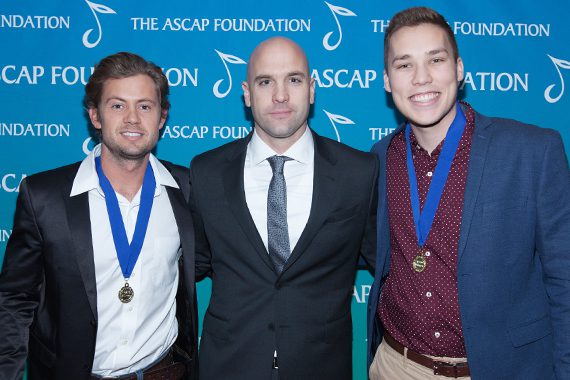
Pictured (L-R): Brandon Lay, ASCAP Creative Director Robert Filhart, Brandon Ratcliff.

Pictured (L-R): Brandon Lay, ASCAP Creative Director Robert Filhart, Brandon Ratcliff.

The 20th annual ASCAP Foundation Awards in New York City on Wednesday, Dec. 9, honored Nashville ASCAP songwriters Brandon Lay and Brandon Ratcliff with The ASCAP Foundation Harold Adams and the Leon Brettler Award, respectively. Hosted by the ASCAP Foundation at Appell Room of Frederick P. Rose Hall, ASCAP Foundation President Paul Williams and ASCAP Foundation Executive Director Colleen McDonough hosted the event.

Lay, a native of Jackson, Tennessee, is signed to a publishing deal with Warner/Chappell Music Publishing and, as an emerging artist, has toured with acts such as Brantley Gilbert, Aaron Lewis, Darryl Worley and more. Ratcliff hails from northern Louisiana and moved to Nashville in 2014 to pursue a career is music. The first song he wrote as a Music City songwriter was recently recorded by Alison Krauss and will appear on her next record.

The event also featured performances by additional award recipients Richard Marx, Joel Grey, Felicia Collins, Maisy Kay, Pascal LeBouef, Alastair Moock, Watson Lark, and Griffin Matthews and Matt Gould with cast members of The Invisible Thread.

The Recording Academy Nashville to Host Production Panel

pe_logoThe Nashville Chapter of The Recording Academy’s Producers & Engineers Wing will host a panel discussion focusing on business, economic and financial aspects of music production, Wednesday, Dec. 16, from 6-8 p.m.

Titled “Lost in Transaction, SoundExchange: Get Plays, Get Paid,” panelists John Strohm (Senior Counsel, Loeb & Loeb LLP) and Linda Bloss-Baum (Senior Director, Artist and Industry Relations, SoundExchange) will discuss how revenue is tracked and collected, and how and what to register with SoundExchange to maximize income. Moderator will be Maureen Droney (Managing Director, P&E Wing).

Admission for Recording Academy voting and associate members is free by today. Guest admission is $25. Complimentary food and drink provided. RSVP to PEWingNashville@grammy.com.

KCA Agency Signs Three, Including Radney Foster

KCA

Keith Case and Associates (KCA)—an artist representation agency—has signed Radney Foster, The Lonely Heartstring Band, and The Campbell Brothers. 

BLA Signs Exile

Exile

Exile

Exile has signed with Buddy Lee Attractions, Inc. (BLA) to continue their more than 50 years of touring.

BLA is the three-time recipient of CMA’s Talent Agency of the Year Award and two-time recipient of the Pollstar Independent Agency of the Year Award.

Exclusive: Downtown Music Publishing Shapes Up in Music City

Downtown Music Publishing's Steve Markland. Photo: Steve Lowry

Downtown Music Publishing’s Steve Markland. Photo: Steve Lowry

Downtown Music Publishing’s VP of A&R Steve Markland will soon celebrate two years since establishing Downtown Music Publishing’s Nashville outpost in 2014. The 3,000-square-foot Nashville office followed Downtown’s Los Angeles office, which opened in 2013. The company is headquartered in New York City, and was founded in 2007.

“I love the size of the company and the challenge of building a new roster and building a presence in Nashville, as well as the cutting edge technology available for admin and collections,” Markland says of Downtown Music Publishing. Markland arrived at Downtown after a stint as Warner/Chappell’s VP of A&R. His previous career stops include Windswept Publishing and Patrick Joseph Music.

Markland is one of three staffers in Downtown Music Publishing’s Nashville “hub,” which serves as an all-purpose career base for Downtown’s music writers. “The space is a big part of our strategy,” Markland says. “Having a hub for writers to come and connect with other writers, work, do emails, work on anything they need to. It’s also a space where they can co-write and have track building facilities or a space to just write with their guitars.”

Along the way, Downtown has been signing, developing, and working with a star stable of writers, including the recent additions of Jason Isbell, Sturgill Simpson, Old Crow Medicine Show, and more. Rosanne Cash (Downtown Music Publishing/Notable Music) was inducted into the Nashville Songwriters Hall of Fame earlier this year. Parallel Music writer (admin by Downtown) Lance Carpenter is a co-writer for Kelsea Ballerini’s “Love Me Like You Mean It.”

“My strategy always starts with the songwriter and the song first,” says Markland. “I try very hard to focus on developing a balanced roster of writers, including developing new writers, veteran writers, producer-writers, and developing artist-writers as well. I try to find that balance, and that adds a great synergy. It makes you a more versatile publisher.”

The company’s offices in major music cities including New York, Nashville, Los Angeles, London and Amsterdam also afford its writers collaborative opportunities. Downtown Music Publishing has expanded its film/television departments in recent years, a move that has also helped its Nashville-based writers. One such success is “Catch Us If You Can,” used in the 2015 movie Hot Pursuit. Downtown writers Sara Haze, Charlie Peacock, Todd Clark penned the title with Lady Antebellum’s Hillary Scott.

“Our head of Film and Television in Los Angeles called with [the] opportunity and I lined up three of our writers [Haze, Peacock, and Clark],” recalls Markland. “Clark writes for one of our affiliate companies that we do admin for. Sara had called me a couple of days prior to the writing session, and said, ‘Hillary Scott just called me and wants to write, but she wants to write the same day we have the write for the film.’ So, we invited Hillary to write on the song for the movie as well, and then Sara and Hillary connected on a different song right after that. It was a really productive day.”

Markland and his team offer opportunities to new writers from day one. “It’s about being available to hear songs and to give feedback, to connect [writers] to those looking for songs, to know where labels and artists are in the process of new albums. Whatever is going on in the Music Row area, we want our writers to know about it. We want to give our writers every opportunity we can. That’s an enormous jumpstart for a career.”

Downtown Music Publishing’s catalog spans over 60,000 titles including the works of such diverse writer/artists as The Beatles, John Lennon & Yoko Ono, Cy Coleman, The Kinks, Randy Newman, Hans Zimmer, Jewel, Neon Trees, and One Direction.

Jason Isbell Lands New Publishing Home

Jason Isbell

Jason Isbell

Grammy-nominated singer-songwriter Jason Isbell has inked an exclusive worldwide publishing agreement with Downtown Music Publishing. Isbell’s latest solo album, Something More Than Free, debuted this summer atop the rock, country and folk charts.

“We are thrilled to be working with Jason and his incredible song catalog,” said Downtown COO Andrew Bergman. “With each new album, Jason’s music continues to reach ever-wider audiences, crossing over to numerous genres. We are truly honored to partner with Jason and his fantastic team.”

“We look forward to doing more licensing, helping him promote his brand, and we’re in a great place for that. We feel like timing wise it couldn’t be better for all of us,” added Downtown Music Publishing’s VP of A&R Steve Markland.

Isbell was originally part of the band Drive-By Truckers before launching a solo career in 2007. In 2014 he took home Americana Music Awards for Artist of the Year, Song of the Year (for “Cover Me Up”), and Album of the Year for Southeastern. He is nominated for the upcoming Grammy Awards for Best American Roots Song (“24 Frames”) and Best Americana Album (Something More Than Free).

Exclusive: Craig Wiseman Shares His Big Loud Vision

Craig Wiseman. Photo: Amy Allmand

Craig Wiseman. Photo: Amy Allmand

The full vision for Craig Wiseman’s enterprise is coming to fruition at 1111 16th Avenue South in Nashville.

That’s where the 2015 Nashville Songwriters Hall of Fame inductee oversees his Big Loud headquarters, offering a true 360-degree artist experience with in-house publishing, management, label, and music production.

“People might demonize 360 deals,” says Wiseman on a late November morning inside the plaque-saturated walls of his three-story office building. “Although this was our first venture together [with Joey Moi, “Chief” Zaruk and Seth England], every entity came in pretty seasoned. Nobody is riding anyone’s coattail in this instance.”

Now with a staff of over 20 in the 16th Avenue complex, the Big Loud Shirt publishing group encompasses the third floor with a songwriter roster that includes Moi, Rodney Clawson, Chris Tompkins, Matt Dragstrem, Sarah Buxton and the Warren Brothers. Chris Lane and Florida Georgia Line’s Brian Kelley and Tyler Hubbard are signed for publishing with Big Loud Mountain.

Wiseman thanks longtime friend and writer Buxton for helping him realize the current business structure.

“Sarah was the only artist I ever produced,” recalls Wiseman of a 2007 six-track EP. “We had 11 songs that we threw over the fence for the label to release in 2005. Everything I feared, overthinking and all that, happened. I stepped back from that saying, ‘Never again!’ If I ever contribute that much heart and soul again, it will be a situation I have far more control of. But when you say that, you’ve gotta get your checkbook out.

“The wheels were falling off the industry that whole time. For us, it came down to: if you want to fish, you better be running a hatchery. When Seth England came along to start this new publishing model—getting good bands in clubs—the old model started working like crazy with Rodney Clawson and Chris Tompkins kicking ass with Blake, Luke, Jason, and Carrie cuts. Though, we still had more great songs than we knew what to do with.”

Soon, the largest-selling digital country song of all time came knocking to not only change the trajectory for Big Loud, but the modern Nashville industry altogether.

“My mother could’ve told you ‘Cruise’ was a hit,” Wiseman says. “But we were lucky that FGL was our first attempt at the new model. Here were two kids starving to death, killing themselves wearing out a Chevy Tahoe. We figured if we put out one independent single, their club date booking price would double and we would recover our investment. We were just trying to keep things simple.

MusicRow: How did FGL’s success light the fuse for Big Loud Records?

Wiseman: The whole goal was to put good music together, pay for it ourselves and do our own thing because when you take outside money, you take an outside timetable, expectations, fears and overthinking. What eventually happened with FGL was supernatural. It’s a perfect storm of so many elements coming together that is unrepeatable. You just thank God that you’re lucky to be anywhere in the vicinity when lightning strikes.

Partnering with Republic Nashville allowed us to scale up. When we partnered with Big Machine, we sold 20,000 single downloads that week. We always wanted to do a label here, but FGL exploded so quickly, you really get acquainted with the phrase “easier said than done.” We could have got greedy, but it would have been a disservice to the guys.

After we got FGL on their way [with Republic], it was Seth’s genius to go after Clay Hunnicutt to run Big Loud Records with [flagship artist] Chris Lane. People aren’t pushing back as hard as I thought they would. We’ll probably get a few more acts out there. But this [enterprise] is more than enough for me right now. We’re at a point where I don’t have to ask anyone’s permission for anything. I’ll live and die by it, that’­s fine—it’s my money. I hope to piss people off and make people smile a little.

Has your success sunk in?

Behind all this, I feel like I’m in the middle of the largest practical joke ever. I literally can’t believe it all. The weird thing was when I asked Tim McGraw and Ronnie Dunn to come sing at the Nashville Songwriters Hall of Fame induction, they both said, “You’re not already in there?”

That honor was amazing, as was the 2014 Heritage Award for the most-performed country music songwriter of ASCAP’s first 100 years. It’s like, “Are you fucking kidding me?” There are some real songwriters out there, and I’m just me.

What keeps you motivated?

I have been incredibly blessed. I spent my first week in town sleeping in a van. In 2000, Almo/Irving [where Wiseman signed his first publishing deal a decade prior] sold. Before I went to BMG, I sold my catalog for million[s], yet it was the most uncomfortable time of my life. I thought, “Is that it? I’m just going to make that pile bigger?”

I was in my mid 30s—didn’t have to worry about where my next house, meal or car would come from—but on an intuitive level I felt like such an ass, using these blessings to make myself comfortable. The story in the Bible about the three individuals entrusted with wealth and one buries it while the others invest it [helped decide the next step].

All I knew was I loved songs and songwriters. So I put $1 million in a business checking account and bought a piece of property on 17th Avenue South with the intention of throwing parties. I was watching all the old publishing companies fall away and I would love to go to these parties they would throw because they brought together a community.

I love watching new artists getting their dreams and prayers answered. And whether or not I help them, just to be around them—who doesn’t need to be reminded that prayers get answered and that angels fly low? I naively didn’t realize the staff answering phones would advance and realize their own dreams, too. Our employees are given the opportunities and in return are given the rewards. There are so many dreams coming true and people working hard. To see the look in their eyes when they catch fire is great to be around.

In 2014, you partnered with Round Hill. Why was that the right decision?

We sold a portion of copyrights but our business is still here. I still own every song. We more or less did a co-venture going forward and kind of a co-venture going back.

The brilliance of Round Hill is they partner. They have a very effective admin and sync organization of about 20 people. I pay very close attention to admin—I owned my own for years. They just run everything through their pipes. Ultimately, I just wanted to be left alone and to be an extremely low-maintenance partner to make us both money. We’re looking at future areas to partner with them. Since, Round Hill has made some very aggressive moves in Nashville.

Are you part of the trend of publishers being the artist developers?

When millions turn into billions, lawyers and investors come in and screw things up and then it’s left to the creative people who love the music to build it back and fix it. Shane McAnally is having major success at development, as is Luke Laird. It’s great to see.

I’m of the old school Nashville publishers who think if you care about an act, you will do anything for them to get them somewhere. That’s where artist development comes in at the publisher level.

Leigh Nash Signs Publishing Agreement With BMG in Nashville

Pictured Left To Right: Kevin Lane (BMG, Creative Director);  Chris Oglesby (BMG, VP – Creative); Ashley Wilcoxson (Thirty Tigers – Manager); Leigh Nash; Daniel Lee (BMG, Senior Creative Director); Kos Weaver (BMG, Executive Vice President); Sara Knabe (BMG, Senior Creative Director)

Pictured Left To Right: Kevin Lane (BMG, Creative Director); Chris Oglesby (BMG, VP – Creative); Ashley Wilcoxson (Thirty Tigers – Manager); Leigh Nash; Daniel Lee (BMG, Senior Creative Director); Kos Weaver (BMG, Executive Vice President); Sara Knabe (BMG, Senior Creative Director)

Songwriter Leigh Nash has signed an exclusive publishing agreement with BMG through the company’s Nashville office.

Nash scored several worldwide hits as part of the group Sixpence None The Richer, such as “Kiss Me.” In September, she released a new full-length solo album, The State I’m In, produced by Brendan Benson, in conjunction with Thirty Tigers.

Nash has been featured in numerous global advertising placements and will continue her work as a recording and performing artist as she strengthens her ties within the Nashville songwriting community.

Hannah Ellis Signs to Word Music Publishing/Wordcountry

Pictured (L-R): Trevor Mathiessen (Word Publishing); Jonathan Mason (Creative Director, Word Worship); Beth Brinker (ASCAP, Creative Director); Scott Safford (Safford Motley); Hannah Ellis; Dale Mathews (VP Word Publishing); Janine Appleton (Creative Director, Wordcountry); Kele Currier (ASCAP Membership); Joel Timen (Creative Director, Word Publishing); Rod Riley (CEO, Word Entertainment)

Pictured (L-R): Trevor Mathiessen, Word Publishing; Jonathan Mason, Creative Director, Word Worship; Beth Brinker, ASCAP, Creative Director; Scott Safford, Safford Motley; Hannah Ellis; Dale Mathews, VP, Word Publishing; Janine Appleton, Creative Director, Wordcountry; Joel Timen, Creative Director, Word Publishing; Kele Currier, ASCAP Membership; Rod Riley, CEO, Word Entertainment

Songwriter Hannah Ellis has signed an exclusive publishing agreement with Word Music Publishing/Wordcountry.

She graduated from the University of Kentucky in December 2012 and moved to Nashville soon after. She is spotlighted in a commercial for the University that is airing now. She also appeared in Season 8 of The Voice.

“It feels good to be at a company with so many opportunities to create in all genres of music, but still very established in country music,” Ellis said. “To have a publisher who is passionate about what I’m passionate about where we have morning meetings each month as a family, some where we pray together, is more than I could have even hoped for when I started looking for a publishing deal.”

“I have known Hannah Banana (yes, I still call her that) since she was 18 years old. I’ve watched her work hard, and heard her grown so much musically since then. I believe in her not only as a writer, but an artist as well, and I can’t wait to see how this story continues to be written,” said Janine Appleton, Creative Director of Wordcountry.

Phil May Promoted to SVP, Warner/Chappell Nashville

Phil May

Phil May

Phil May has been promoted to Senior Vice President & General Manager, Warner/Chappell Nashville. Warner/Chappell Music (WCM), the music publishing arm of Warner Music Group, announced the promotion on Thursday (Dec. 3).

In this role, May will oversee business development, songwriter negotiations, finance, acquisitions, and royalty and copyright and contract administration for the major publisher’s Nashville operation. He previously served as Vice President & General Manager.

“Phil May is professionalism personified,” said Ben Vaughn, Executive Vice President, Warner/Chappell Nashville. “The writers and staff of Warner/Chappell Nashville are fortunate to have such a knowledgeable, hard-working, and caring person on their team. It’s with great pleasure that we announce this well-deserved promotion.”

“Warner/Chappell songwriters and staff are the best in the business—they are loyal, passionate and talented people,” said May. “Working with them is a pleasure that I never take for granted. I’m honored to take on this role, and am grateful for the continued support of Ben Vaughn and Jon Platt.”

May joined Warner/Chappell in 2009. He was previously one of the Founding Partners of global music publisher R2M Music LLC, where he worked on catalog valuations and acquisitions, and integrated acquired catalogs into R2M Music’s portfolio.

Before that, he spent 11 years with Sony/ATV Music Publishing, including as VP of Global Administration, where he headed the company’s U.S. and international royalties, copyright, licensing, and information systems departments.

The Producer’s Chair: Jeff & Jody Stevens

Jody and Jeff Stevens

Jody and Jeff Stevens. Photo: Andrew Dorff

By: James Rea

Jeff and Jody Stevens appeared on The Producer’s Chair on Thursday, December 10, 2015, at Douglas Corner at 6 p.m.

I was floored when I found out that father and son Jeff and Jody Stevens, who are co-producer’s on Luke Bryan’s Kill the Lights album, share such amazingly similar journeys. They were both completely immersed in music long before their teens. They’re both hit songwriters and multi-instrumentalists. They were both signed to major labels as artists. They both signed to major publishing companies and now they have both knocked it out of the park as producers on their second time at bat.

(After his duo Fast Ryde ended, Jody co-produced Cole Swindell’s self-titled debut album. Jeff produced Jerry Kilgore in the 1990s.)

In contrast, Jody is an SAE graduate and an engineer and programmer, but Jeff is not an engineer, and they come from two completely different generations musically. Jeff grew up on traditional country and Jody grew up on 90s country, rap and alternative music. So considering where country music has gone … good call, Luke.

“If you’ve ever tried to do something artistic with a relative, I would guess that 99.9 percent of the time it’s a mess,” says Jeff, who recorded for Atlantic in the late 1980s. “But for whatever reason we work really well together. I have such a high degree of respect for what he does and how he goes about what he does. He does for me too. We are able to stay out of each other’s way. That’s probably the secret to it.”

Being Jody’s first appearance on The Producer’s Chair, I asked him: “What is the best advice Jeff ever gave you about producing?”

He replied, “You need to do what the artist wants. When you say ‘producer,’ you know, we aren’t making our record. It’s the artist’s record.”

In 2014, Crash My Party received Billboard’s Top Country Album of the Year, while Cole Swindell’s single “Chillin’ It” went through the roof and has now sold 427,500 copies.

Jody performed all instruments on that track and he’s a co-writer on Cole’s current single, “Let Me See Ya Girl,” which brings us full circle back to Kill the Lights.

Not only did Jeff and Jody co-produce the album, but they both sang back-up vocals with Perry Coleman, Hillary Lindsey and Jennifer Wrinkle, they both played keyboards, they both played electric guitars along with J. T. Corenflos, Kenny Greenberg, Adam Shoenfeld, and Ilya Toshinsky. Jody also played banjo, acoustic guitar and did all the programming on the album. Now that’s what I call father-and-son teamwork, and it don’t get much cooler than that.

The Producer’s Chair: Jeff, you have said, “[Jody] brings the new school, and I bring the old school to the table.” Can you elaborate?

Jeff: Well, I tend to come at it from more of the pragmatic [perspective], sort of, “All I need is a guitar and a piece of paper,” you know? While I’ve seen him write that way, Jody comes more off-the-wall than I do. I have to wade through a bunch of ordinary stuff. With him it’s just off the cuff, different. I don’t know if that’s old school or new school or not.

I think that I can’t help but pull from artists as far back as the ‘40s, Carl Smith and Faron Young in the ‘50s, Merle Haggard, Waylon Jennings and Johnny Cash in the ‘60s and Waylon and Buck Owens in the ‘70s. I was there firsthand. So, all of that stuff goes through my brain, whereas [younger producers] don’t go to that stuff. They go to their stuff.

I bring the old-school Nashville way of tracking a band. I can’t mix something myself. I have to have a mix-down engineer to do all that. Cole Swindell’s first single – everything on there was Jody. So, we both have different talents. When it really comes to producing a vocal on somebody, I have 40 years of experience. When it comes to working inside of a track, Jody has so much more experience and is gifted with that.

The Producer’s Chair: Was co-producing with Jody something that you had in the back of your mind all along, or did the whole thing happen organically?

Jeff: I would say that it happened because he had a duo called Fast Ryde [formerly signed to Republic Nashville]. It has been said by other people—and I would say that they’re probably right—this wave of music that ended up being termed somewhere along the way ‘bro country.’ Fast Ryde was the first act to sound like that, and that is because of Jody. So, when I heard his demos, I asked if I could co-produce it with him. … I wanted to keep the rawness of it, but make it so that the average person could hear it and not be turned off by some of the raw stuff on it.

So, when we worked on that together it was pretty apparent that we worked well together. That’s been five or six years ago now. Ever since then, we both work on different things, but we both kept just getting in each other’s way, kind of. It made sense for us. You know, he’s got his own things that he produces on his own. I have to admit that I’m not producing anything on my own right now. I feel like I have to have him around. He’s got a lot of stuff going on.

The Producer’s Chair: What is your engineering and programming background?

Jody: Well, Dad bought a 4-track recorder sometime around ’92 or ’93. I was making recordings and stuff on it. I never really thought much about what I was doing. I was just kind of having fun. That’s pretty much what I do now. So, I figured I’d record on it. My dad showed me that if you recorded three tracks you could record those to another track and then have another three tracks to keep recording. You had to mix and match. There was no EQ’s or anything on those.

I didn’t just record by myself on the 4-track. I had a buddy that played drums. So, I would play the guitar and he would play drums. I would sing something on it. Most of it was probably cover songs. Some stuff I was just making up out of thin air, you know?

The Producer’s Chair: How old were you when you started?

Jody: Probably 12. Just a couple years later we bought a digital 8-track recorder that had a lot more functionality. It was a Roland VS-880. I tried to read the manual. I couldn’t really understand it. I asked Dad how to use the thing. He showed me how to turn it on, hit record, and do the tracks. It had effects. So, it was kind of cool that it had effects. There were EQs and stuff, and I didn’t even know what I was doing. So, I just turned the bright up on everything. I just turned the high end up on every track. The low end was a smiley face curve on the whole thing.

So, around 2000—the year I graduated high school—the big audio company DigiDesign made an interface called the Digi001 which went with ProTools. You could record in your house on a computer. … I think it was ProTools 5 that had 24 tracks, which was three times the tracks I had on the VS-880 plus there was waveform editing. So, you could just kind of move stuff around and put stuff in reverse—do whatever. There was lots of really cool stuff. AutoTune came out around the same time. It was fun to sing into it and hear your voice doing a bunch of wacky stuff. Dad had to buy a custom-built computer to run ProTools. It was a 700 megahertz computer.

The Producer’s Chair: What inspired you to start writing?

Jody: Being in Nashville, I listened to a lot of country music in the ’90s. Whenever I would get in the car with my parents they were always listening to that. I would be listening to a lot of classic rock like Fleetwood Mac and Meat Loaf’s Bat Out of Hell and really diving into Led Zeppelin and Pink Floyd’s Dark Side of the Moon. Kind of classic records for me to be listening to at the time. As I was listening to that I was also listening to a lot of alternative rock. When grunge disappeared—the back half of the ‘90s was alternative rock. I got to watch a lot of those bands play live. I just loved it. I didn’t know why, but I loved it.

So, I wrote from 2006 to 2007. I wrote a couple hundred songs by myself. I think I was trying to learn—

Jeff: If I could just interject. He would send those to me. Sometimes I would play them for his mother. I was like, “This is unbelievable.” It was the melodies. The take he had on it was like nothing I had ever heard before. I told his mother, “I don’t know what’s going to happen with him.” I’m super tough on myself and on my own songs. I’m afraid I am on everybody around me. So, when I heard some of those things at that time in his life I went, “Wow! That’s incredible.” My brain can’t even think of being able to do something like that.

The Producer’s Chair: How do you feel about artist development?

Jody: I think development is necessary in trying to figure out who the artist is and what kind of records they should be making. In many ways, I do artist development. There are some acts that I work with now. There’s a band called Backroad Anthem that I work with. They’ve been around town for about a year. We have been in the studio to record some stuff. They have shows and I come to them. Sometimes I go to rehearsals. I have another friend that I work with named David Ray. I went this past weekend to go watch him play in Iowa.

Jeff: There are artists who walk in and everything is already taken care of. They come in, they sing, and then they go fishing. They get to pick the songs, and to a degree—sometimes the songs are picked for them. But an artist’s true potential can more likely be achieved when they’re playing music that is of them—not done for them.

Mickey Jack Cones Launches Cor Entertainment, Co-Venture With Combustion Music

unnamed

Pictured (L-R): Mickey Jack Cones, Cor Entertainment; Chris Van Belkom, Combustion Music; Jordan Walker and Johnny McGuire of Walker McGuire; Chris Farren, Combustion Music; Kenley Flynn, Combustion Music.

Producer Mickey Jack Cones has launched Cor Entertainment, including the subsidiaries Cor Music Publishing, and Cor Artist Services. The company has entered into a co-venture with Combustion Music.

The first artist signed to the new venture is duo Walker McGuire, which includes Jordan Walker of Vernon, Texas, and Johnny McGuire of Fairway, Kansas. The duo formed in 2012, and spent years performing at Nashville writers nights. The duo was featured by radio show hosts Big D and Bubba each week on the radio talent show, Chasin’ The Dream.

“I will definitely keep producing, but I’m branching out and able to have a little more creative control,” says Cones. “When you are just producing there are so many other elements that can make or break that album and artist. I feel I have new perspective to offer. I’ve been on the Rascal Flatts tour, I’ve done some tour management, I’ve been on radio tours. With the right act, I feel like I can bring all of that to the table to help streamline things where all these sidesteps are involved to get from A to Z.”

For a full profile on Mickey Jack Cones, click here.